Operationalizing a Control Calendar Across Multiple Compliance Frameworks
Unify compliance frameworks into one control calendar to eliminate duplicate auditing work.

Six weeks before an audit, the same scene plays out in compliance teams across every industry: someone is digging through shared drives for screenshots of last quarter's access review, because the SOC 2 auditor wants it in one format, the ISO 27001 assessor wants it in another, and the NIST-aligned customer questionnaire wants it described a third way. What changes is the folder it has to live in. That duplication is not a staffing problem or a tooling gap; it is the predictable output of treating SOC 2, ISO 27001, NIST, and other frameworks as separate initiatives, each with its own control inventory, its own evidence repository, and its own calendar, so that one underlying activity gets performed and documented three or four times over for three or four auditors who are, in substance, asking the same question.
Parallel Compliance Tracks and the Problem a Unified Control Library Solves
It's simple to describe the architecture behind parallel compliance tracks, but it's expensive to live with. A SOC 2 program builds its own list of controls and evidence folders. The access review that satisfies all three gets performed, and documented, as though it were three distinct activities, because no one built the connective structure that would let one evidence event serve all three audiences at once.
Compliance monitoring research consistently identifies evidence gaps as the most common compliance failure: controls that technically run but leave no traceable record an auditor can inspect. A scramble-before-audit program produces exactly that, because the evidence gets assembled retroactively, under deadline pressure, by people reconstructing what happened months earlier.
The deeper cost occurs between audits, where a team that passes its SOC 2 audit in January can accumulate configuration drift and access drift for eleven months before the next scheduled check catches it. Risks emerge and persist in the window the audit calendar was never built to cover, and the organizations running this model experience a compounding form of audit fatigue: the same personnel re-answering the same evidentiary questions, quarter after quarter, framework after framework, with diminishing confidence that any of it is improving the actual security posture.
Practitioners who defend the parallel-track approach object most often that you simply can't merge the frameworks, since one framework speaks in trust criteria, another in an annex of controls, and a third in a cybersecurity framework, and they audit on different cycles. That is true at the level of requirement language. It is false at the level of the underlying control. Most organizations running two or three overlapping frameworks already perform far more shared control activity than their separate audit tracks reveal, because the requirement text differs while the operational action, an access review, a configuration scan, a vendor assessment, stays the same underneath it.
What a unified control library contains
A Unified Control Framework consolidates and harmonizes regulatory, industry, and internal controls into one centralized structure, so every internal control gets mapped and linked to every framework requirement it satisfies. A control library of this kind replaces nothing the organization is already doing; it connects what the organization already does to what each framework asks for, removing the need to manage separate compliance requirements as though they were separate jobs.
A completed library has a few structural components that matter more than any particular software choice. With centralized control management, you keep all compliance requirements and their matching controls in one place, instead of scattering them across framework-specific binders or drives. Control mapping links equivalent controls across regulations directly: a single Access Control Policy, properly mapped, satisfies NIST CSF, ISO 27001 clause A.5.15, PCI DSS, and SOC 2 Common Criteria CC6.1 simultaneously, with one policy document doing work that four separate programs might otherwise duplicate four times. With risk visibility, leadership gets a single view of exposure across every standard the organization carries, instead of a fragmented picture assembled framework by framework. And the library has to scale: it needs to absorb new frameworks, or new versions of existing ones, without a ground-up rebuild each time.
The frameworks a modern control library has to accommodate span a wide range: HIPAA for healthcare organizations and their business associates, PCI DSS for anyone handling payment card data, GDPR and CCPA for data privacy obligations, CMMC for defense contractors, alongside general-purpose frameworks like ISO 27001, NIST CSF, and SOC 2. A working library serves four distinct purposes a spreadsheet does not: it simplifies the complexity of managing several frameworks at once, it creates operational efficiency through standardized control language, it mitigates risk by consolidating visibility instead of leaving it siloed by framework, and it establishes accountability through governance mechanisms that tie controls to named owners and documented outcomes.
A control library is not a document that gets built once and filed away. Frameworks themselves change. NIST CSF 2.0, PCI DSS v4.0.1, and ISO 27001:2022 each introduced structural revisions to the requirements a library has to map against, and each revision means the mappings built against the prior version need to be revisited. A library that isn't updated at each framework revision cycle quietly becomes inaccurate, which defeats the purpose of building it centralized.
Building the master control matrix: the mapping step by step
To build the master control matrix, you map internal controls on one axis against each framework's specific requirements on the other, so a single evidence event satisfies multiple frameworks at once.
The build should start with the organization's own controls, not with the frameworks. If you start from a framework checklist, you end up with a framework-shaped list of controls that duplicates the same underlying activity under different labels for each standard. Only after that inventory exists does it make sense to ask which framework requirements each activity satisfies.
The foundation of any compliance monitoring program is a control library that ties security and operational controls directly to the specific requirements of each applicable framework, rather than leaving that connection implicit or undocumented.
A single example shows the payoff concretely. You perform the review once, you tag the evidence once against all three citations, and that tagged evidence then applies everywhere it's needed, without being regenerated for each auditor. That single act of tagging once and applying it broadly is what the whole mapping exercise pays off in.
The process also reveals where internal controls don't yet satisfy a framework requirement. Where no existing internal control satisfies a particular framework requirement, that gap becomes a candidate for a new control or an enhancement to an existing one, rather than the seed of a new parallel compliance track running alongside the others. And the mapping needs validation against each framework's actual published language, not against an organization's informal understanding of what a framework asks for, since control mapping only works if the documented requirement, the system or process the control applies to, and the evidence it produces are all verified against the source text.
Framework revisions complicate this ongoing maintenance in a specific, traceable way. NIST CSF 2.0 introduced a new "Govern" function that did not exist in the prior version, and that function maps directly onto SOC 2's governance-related Common Criteria, the CC1, CC2, and CC3 series covering control environment, risk assessment, and monitoring, and onto ISO 27001's clauses covering organizational context, leadership, planning, and support. If an organization works across all three frameworks, that intersection gives the matrix a natural anchor point for governance-tier controls, and the alignment across frameworks there is unusually direct, not approximate.
Translating the control library into a sequenced calendar
A control calendar functions as the temporal layer sitting on top of the mapping work: it assigns when each control gets tested, who tests it, and at what evidence frequency. Because the calendar draws from a library already mapped across frameworks, one scheduled activity on it can drive evidence for every applicable standard at once.
Frequencies on that calendar need to follow the risk level of the control, not audit convention or whichever cadence happens to fit existing staff schedules. PCI DSS 4.0 formalized this logic through targeted risk analysis, so you can justify your control review frequencies based on your actual risk environment, not a default you inherited from a prior audit cycle. The same reasoning extends to the whole calendar: frequency should be a documented, deliberate decision tied to risk, not a holdover from whatever schedule the last audit happened to use.
That calendar organizes cleanly into three tiers. The continuous or daily tier covers automated tests for high-frequency controls, authentication checks, access provisioning, encryption status, where each test produces a timestamped result without anyone initiating it manually. The quarterly or annual tier covers vendor compliance reviews, policy reviews, tabletop exercises, and framework mapping refreshes, anchored to the broader audit cycle but spread across it rather than compressed into the weeks just before an audit begins.
Every entry on the calendar needs five things specified: the control being tested, the frameworks whose requirements that test satisfies, the evidence artifact it produces, the system that generates the artifact, and the named owner responsible for making sure it happens. NIST CSF 2.0's "Govern" function offers a practical starting point for the governance tier of this calendar specifically, since its mapping to SOC 2's CC1, CC2, and CC3 series and to ISO 27001's clauses on context, leadership, planning, and support means governance-tier calendar entries can be built outward from that intersection rather than invented from scratch for each framework separately.
The calendar's audience is expanding beyond internal use. Current best practice ties calendar tasks directly to written policies, adjusts frequency based on documented risk rather than tradition, removes tasks that no longer apply to the organization's current environment, and aligns calendar evidence with annual review documentation. The calendar has stopped being purely an internal planning tool, because regulators themselves now inspect it.
Assigning control ownership so the calendar runs without a pre-audit sprint
If a control calendar has no named owner, it defaults to collective responsibility, and in practice that means no one collects evidence until an auditor asks for it directly. Unclear ownership is one of the most common root causes behind audit failure.
The RACI structure, Responsible, Accountable, Consulted, Informed, remains the standard tool for assigning that ownership, but its failure mode is well documented: evidence collection and access validation consistently rank among the biggest audit problems enterprises face, and the root cause traces back to ownership that was never made explicit. When responsibility gets diluted, gaps open and governance failures take root quietly in the months between audit cycles.
Every control in the library needs a named Responsible owner, the person who actually runs the test or collects the evidence, and a named Accountable owner, the person answerable if the control fails, along with defined Consulted and Informed parties. Assigning that ownership once at the outset isn't enough: it has to be revisited whenever personnel change, systems change, or new framework requirements get added to the library. A single access review might involve IT running the report, HR confirming which employees actually left the organization, and Security validating the scope of what was reviewed, and the calendar entry needs to name all three roles explicitly, not just the team that initiated the review.
The clearest payoff of building ownership on top of a unified library, rather than on top of separate framework tracks, is structural. Because each control is already mapped to every framework requirement it satisfies, the owner of that control is implicitly the owner of the framework requirement too. A single owner runs the same control, on the same schedule, whether it is labeled an ISO 27001 control or a SOC 2 control.
Automating evidence collection so the calendar produces a continuous audit trail
Manual control testing produces periodic spot-checks. Evidence collection that runs on a defined schedule and produces a timestamped result without a person having to initiate it each time turns a control calendar into a continuous audit trail.
Automated control testing evaluates whether a control is functioning against its expected configuration and logs a timestamped result each time it runs, with failures triggering alerts as they occur during normal operation. The evidence library grows steadily across the year as a byproduct of that testing, so there is no dedicated collection sprint compressed into the weeks before an auditor arrives.
Real-time evidence collection is what actually eliminates the pre-audit scramble described at the start of this piece. Automated ingestion pulls evidence directly from the tools and systems that generate it as a normal part of daily operations, populating the library continuously.
Continuous Control Monitoring applies automation, increasingly paired with AI, to test controls continuously across cloud, on-premises, and hybrid environments. With that continuous testing, organizations can catch control failures earlier and keep an accurate view of risk posture in the stretch between formal audit cycles, and that closes exactly the eleven-month visibility gap that point-in-time audits leave open.
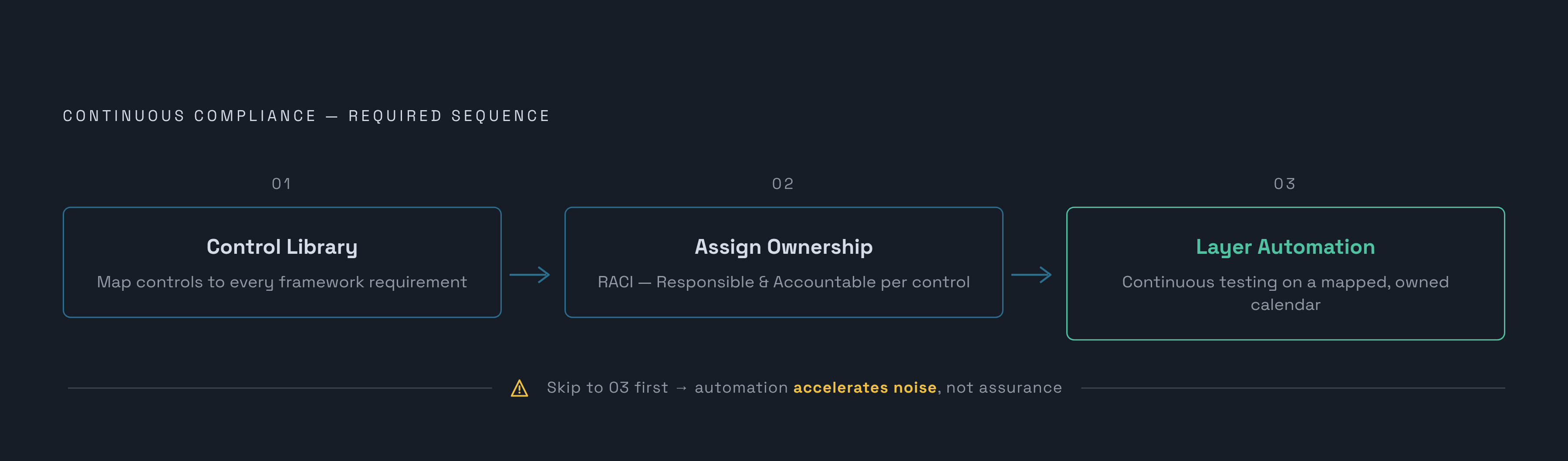
The library and the ownership structure behind it have to be sound before automation pays off. Applying automated testing to a poorly designed calendar accelerates the production of noise, generating alerts and logs against controls that were never mapped correctly or owned clearly. The sequence matters: the library gets built first, ownership gets assigned second, and automation gets layered on third, to sustain a cadence that was already working.
Sources
- Unified control frameworks: Simplifying multi-standard compliance in 2025
- What Is Unified Compliance Framework? UCF Controls Explained
- The Unified Control Framework: Establishing a Common Foundation for Enterprise AI Governance, Risk Management and Regulatory Compliance
- Everything to Consider When Integrating Risk and Compliance Operations
- Controls best practices: compliance guide & tips for 2026
- Compliance Automation Software: A Practical Guide for 2026