Third-Party Integrations and In-Scope Data Flow Decisions
Integrations pull third-party vendors into your compliance scope whether you notice or not.
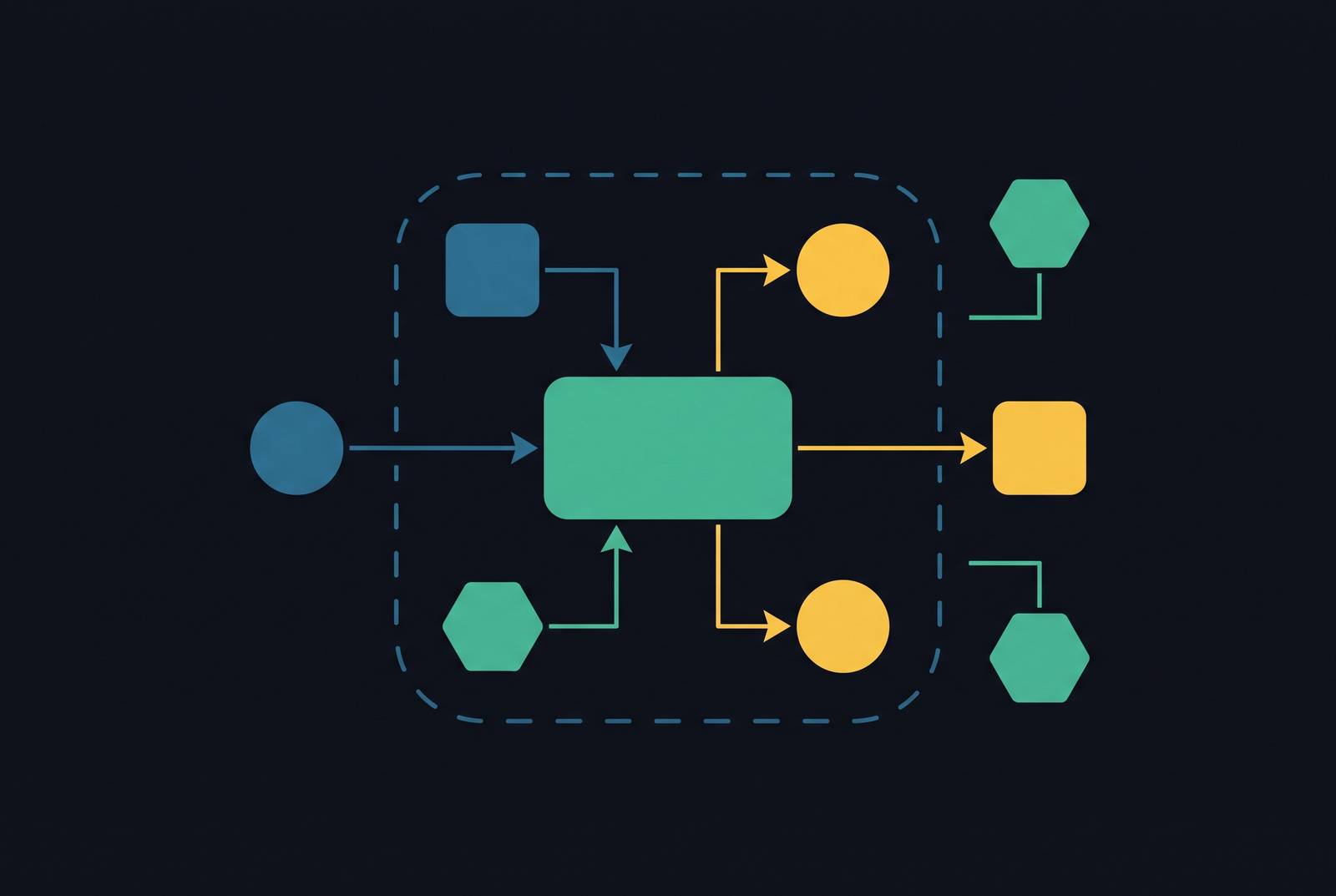
A product manager approves a new connector that pulls customer records into a support tool. An operations lead can sign off on a managed file-transfer platform to move invoices between the finance team and a vendor. Neither of these looks like a compliance decision at the moment it's made. Both of them are. The moment data leaves an organization's own servers and enters a third party's infrastructure, that path becomes part of what has to be secured, monitored, and accounted for during an audit. The integration decision and the scoping decision are not two separate choices made by two separate teams. They are the same choice, made once, usually by someone who isn't thinking about compliance.
Most organizations don't treat it that way. The common model splits the work cleanly: engineering and product pick the tools that make the business run, and a compliance team comes along later to figure out what falls under PCI DSS, SOC 2, or whatever regulation applies. That split is the reason so many organizations get surprised by their own scope. By the time the compliance review happens, the integration is already live, already moving data, and already has an answer to the question "is this in scope" baked into its architecture, whether anyone asked the question or not.
The mechanism is straightforward: when an application requests data from a third-party system, that data travels through the integrator's own infrastructure, and often through additional vendors behind that integrator that the organization never directly contracted with. Each one of those hops is a new path that has to be accounted for, created the instant someone clicked "approve" on the integration request. Scope no longer stops at the systems that directly touch regulated data; compliance frameworks have widened it. A vendor that only configures permissions, manages authentication tokens, or handles some adjacent piece of a workflow can still pull an entire integration chain into scope, because that vendor has the ability to affect the security of data it may never actually see.
This matters because it determines who is positioned to catch a scope problem before it becomes real exposure. A compliance team running a retrospective audit is always working from a map that's already out of date, because engineering and product teams have kept adding integrations in the time between one audit and the next. Treating scope as something to be discovered after the fact guarantees the organization is always behind its own risk surface.
Where frameworks draw the edge of in-scope data flows
Regulatory frameworks have hardened their language on scope because data no longer stays inside one system, and the rules have followed the data rather than the org chart. PCI DSS v4.0's Requirement 12.5.2 now makes formal scoping validation mandatory, closing a gap where organizations had been allowed to operate on scope definitions they wrote themselves, often years out of date. The requirement answers two questions directly: where can payment account data travel, and which systems have the power to change the security of those paths. A diagram that only shows a payment API and its database misses the systems that deploy code, manage identities, decrypt records, or receive data for troubleshooting, all of which can affect the cardholder data environment even without holding card numbers themselves.
SOC 2 carries a related tension, but this one is commercial rather than purely technical. A narrower scope is easier and cheaper to certify, but it may not satisfy a buyer who wants assurance covering the organization's full service delivery environment. The scope decision here isn't only a security question. It shapes what the resulting report is actually worth to the people reading it.
DORA entered into application on 17 January 2025, and it pushes the same logic further upstream. It extends compliance obligations to SaaS vendors selling into EU financial entities, including banks, insurers, investment firms, payment providers, and crypto-asset service providers. Every third-party API shipped into one of those environments becomes a piece of ICT supply chain that the financial entity has to register, monitor, audit, and be able to exit cleanly if needed. DORA's Register of Information requirement goes a step further still: a financial entity has to list not just its direct vendors but the subcontractors those vendors rely on to deliver services that support critical functions. The scoping obligation doesn't stop at the first vendor relationship. It cascades down the chain. GDPR runs in parallel wherever personal data of EU residents moves through any of these integrations, and satisfying DORA doesn't satisfy GDPR on its own; the two frameworks have to be worked through separately even when they govern the same data flow. By 2026, national competent authorities are running active enforcement reviews and issuing compulsion payments, so the enforcement posture around DORA has shifted from checking paperwork to demanding proof of actual operational resilience. The informal tolerance period that followed DORA's 2025 start date is over.
Three frameworks, three different origins, and the same conclusion. PCI DSS, SOC 2, and DORA are each independently defining scope by where data flows and who can affect its security, not by which systems an organization happens to own or what a vendor contract happens to say.
The specific integration patterns that silently expand scope
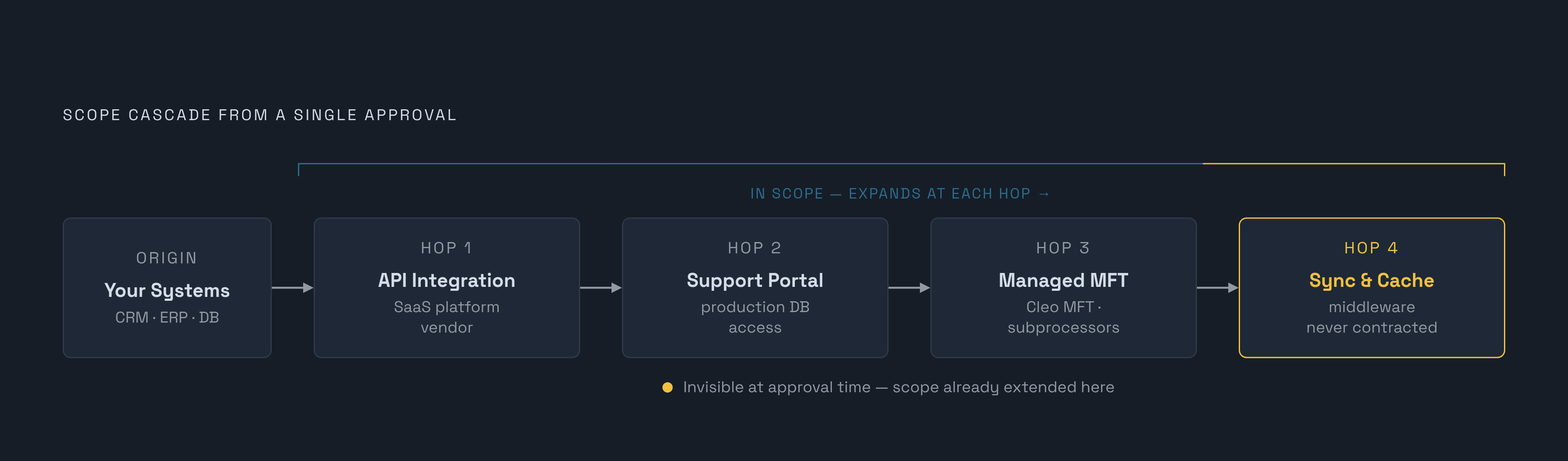
Some integration architectures carry scope risk you can barely see at the moment of approval, and once it's built, it's hard to contain.
API integrations with SaaS platforms are the most common version. When an application pulls data from a third-party SaaS system, that data moves through the integrator's infrastructure and sometimes through additional vendors behind it. The exposure isn't only about whether the vendor holds regulated data; it's about whether the vendor's API access is broader than it needs to be. If an API scope is overprivileged, a vendor can affect security outcomes even in moments when it isn't actively touching a single regulated record.
Customer support portals with production database access follow a similar pattern, for an understandable reason: support teams need real access to solve real customer problems, so they're often given broad reach into production systems. Because of that level of access, the support vendor's authentication controls, security posture, and internal employee practices all sit inside the organization's compliance perimeter. A missing multifactor authentication step on a support portal is a gap in the organization's own perimeter. The PowerSchool breach, running from December 2024 into 2025, shows how this plays out: an intruder used a compromised employee password to get into PowerSource, PowerSchool's customer support portal, which had production database access and no multifactor authentication in place. Records belonging to tens of millions of students and educators worldwide were exposed, and substantial financial losses followed in the aftermath.
Managed file-transfer platforms carry a different kind of risk; it comes from shared infrastructure, not overprovisioned access. These tools sit at the intersection of many organizations' data flows at once, so a single compromise at the platform level brings every customer's in-scope data into the blast radius simultaneously. The Cleo MFT platform, used by organizations including WK Kellogg and Hertz, was compromised in December 2024, and the incident makes the point cleanly: one shared integration tool created in-scope exposure across unrelated enterprises at the same time, none of whom had any direct relationship with each other.
Sync-and-cache middleware works as a unified API layer that aggregates and temporarily stores data from several third-party systems to speed up development, and it introduces a quieter version of the same problem. The cache is itself a data store, and the middleware vendor operating it becomes a subprocessor that has to be registered, assessed, and, if the relationship ends, exited cleanly under DORA, GDPR, and PCI DSS all at once. The developer-experience gains these tools offer let teams aggregate and temporarily store data from several third-party systems quickly, and proponents argue the architecture is fine as long as it's properly isolated. For a regulated buyer, though, the caching layer creates in-scope surface area, and that's genuinely hard to map and audit after the fact.
Not every scope expansion comes from an attack. SaaS tenant misconfiguration, things like overly broad guest user permissions, exposed API endpoints, or loose sharing settings, routinely exposes data with no breach involved at all; the exposure comes from a configuration decision, not an intrusion. Procurement and supply-chain vendors carry a related risk at a different layer: they often hold employee records, financial data, and organizational metadata across many client organizations simultaneously, so a breach at the vendor level becomes a breach across every one of its clients at once. And with shadow SaaS, employees upload sensitive data to applications the organization never approved, so data keeps moving outside the formal data-flow map. That data is in scope the moment it lands in an unsanctioned tool, whether or not the organization knew the tool existed.
The blast radius of a missed scoping decision
When scope isn't managed with intention, a breach at a single vendor now routinely spreads into simultaneous exposure across multiple downstream organizations that have no direct relationship with each other. That spread is a function of integration density, not simply a sign that one vendor had weak security.
The structural reason: most organizations rely on a small set of high-traffic integration tools, file transfer platforms, identity providers, payment processors, analytics pipelines, and a successful attack on any one of them reaches every organization depending on it at the same time. That's concentration risk, and it comes through shared integrations, not through any single company's mistake. Large supply-chain and third-party compromises have nearly quadrupled since 2020, as attackers increasingly aim at trusted ecosystems instead of a single company's perimeter, treating supplier trust paths, SaaS integrations, CI/CD systems, and vendor identities as targets worth attacking directly.
The fallout from a missed scoping decision isn't confined to technical cleanup. A third-party breach can trigger data breach notification obligations, regulatory and contractual review, operational downtime, damaged trust with customers, delayed sales cycles, closer scrutiny from insurers, and pressure to report up to the board, all stemming from a vendor relationship the organization never fully mapped. Cross-border data flows add a separate layer of complexity: any integration that routes personal data of EU residents across international borders needs its own legal analysis and safeguards under GDPR, on top of whatever other framework already governs that data. An integration approved purely for operational convenience can create legal exposure across multiple jurisdictions that nobody flagged at approval time.
AI vendor relationships are becoming the newest version of this problem. Model APIs and agent frameworks are now being pulled into governance reviews regardless of how an organization initially classified them when it signed the contract. If an AI vendor processes customer data, it sits inside the compliance perimeter, whether or not the contract language acknowledges that fact.
The pattern across all of this is the same: the vendors most widely adopted across an industry carry the most systemic risk, not the least. A gap at one of those heavily shared vendors doesn't stay contained to one customer; it propagates across every organization that built on top of it. Wide adoption is a risk multiplier here, not a signal of safety. Organizations that haven't mapped how their integrations actually expand their scope are carrying risk they have no visibility into at all, and that blind spot doesn't announce itself until a vendor somewhere in the chain is compromised.
What a responsible in-scope data flow decision process requires
If you manage in-scope data flows well, you treat every integration approval as a formal scoping decision, with the same rigor you'd apply to drawing a compliance boundary.
That starts with a complete data-flow map built before an integration is approved. The map has to trace data from the point it's first captured through every hop that can touch it or affect its security, including subprocessors, support platforms, backup systems, and analytics feeds. An integration that can't be mapped to this standard shouldn't be approved until it can be. That map isn't a document built once and filed away. Every new integration requires an update to it, and frameworks including PCI DSS v4.0's Requirement 12.5 now make recurring, formal scoping validation a requirement rather than a best practice.
Due diligence on a vendor has to assess permission exposure directly. That means validating API scopes, OAuth tokens, service account permissions, and whether access follows least-privilege design. A vendor holding overprivileged access is in scope even if it has never caused an incident, because the exposure exists before anything goes wrong.
Multifactor authentication and least-privilege controls need to apply to every vendor access point that carries privileged reach, including internal staff. The PowerSchool case demonstrates that a support portal with production database access is exactly as sensitive as any internal system, and the authentication standard applied to internal privileged users has to extend to any vendor holding equivalent access.
Subprocessors belong in scope from the start of the relationship. A vendor's own third-party dependencies, its subprocessors, sub-SaaS tools, and infrastructure providers, are part of the integration's scope the moment the integration goes live. DORA's Register of Information requirement makes this explicit for financial entities, and SOC 2 auditors are applying the same logic elsewhere. Vendor contracts need to name subprocessors outright and give the organization the right to audit their controls or receive evidence of them.
Vendor inventory and data-flow mapping have to include shadow SaaS and unsanctioned AI tools, the applications employees are already using without formal approval. A map that only covers sanctioned integrations will understate the organization's actual scope every time, because it's measuring the approved picture instead of the real one. Due diligence at the application level has to look past the vendor's general security posture and ask specific questions: what access does this particular application hold, what data does it touch, what systems does it connect to, and is that level of exposure acceptable given how the tool is actually used day to day.
Tenant configuration and sharing controls need a place inside every SaaS review. Guest user permissions, public API endpoints, and overly broad sharing settings are scope and security concerns in their own right, even if a breach never occurs. Cross-border data flows need the same early attention: if an integration routes personal data of EU residents through a vendor or infrastructure located outside the EU, the legal basis for that transfer has to be established before the integration goes live, not discovered later during an audit.
Finally, you need a clean-exit path built into every critical integration from the start. DORA requires financial entities to be able to exit ICT third-party relationships cleanly, and in practice that means integration architectures can't be allowed to create lock-in that blocks migration, and vendor contracts need to spell out data return and deletion obligations before the relationship ever begins. Centralizing all of this, vendor inventories, data-flow maps, permission audits, and exit terms, into a single auditable system of record is what turns scoping from a recurring scramble into a decision an organization can actually stand behind when a regulator, an auditor, or a customer asks to see it.