Continuous Evidence Collection vs Point-in-Time Sampling
Continuous monitoring catches compliance drift that annual snapshots miss until it's too late.
- Written by
- Compliance Primer Editors
- Updated
- October 20, 2026
- Reading time
- 11 min read
- Sources cited
- 7 sources ↓
What this covers
Compliance evidence comes in two structurally different forms, and confusing them is one of the more common ways audits go sideways. Point-in-time sampling checks whether something was true on a given date. Continuous evidence collection tracks whether something stays true across a stretch of time. Both are legitimate. The trouble starts when a team uses the wrong one for the wrong control, and given how many companies are still running annual audit sprints against infrastructure that changes hourly, that mismatch is more the rule than the exception.
NIST SP 800-137 defines the continuous side of this as information security continuous monitoring, or ISCM: maintaining ongoing awareness of security posture, vulnerabilities, and threats well enough to support risk decisions. Worth noting up front, because people misread this constantly: NIST does not claim "continuous" means uninterrupted. Even automated checks run at discrete intervals. The word just means frequent enough that the gaps between checks don't matter for the decisions being made. Point-in-time sampling, meanwhile, is the model most people already know from traditional SOC 2 Type II and ISO 27001 work: a snapshot, dated, filed, done.
Auditors care about this distinction because it maps to a real evidentiary question. If the question is "was this true on date X," a snapshot answers it fully. If the question is "did this hold across the whole audit period," a snapshot answers nothing, no matter how good it looks. Treating the second kind of question with the first kind of evidence is a documented source of audit deficiency findings, not some rare edge case reviewers stumble into once a decade.
Where point-in-time sampling still earns its place
Some controls are, by nature, events rather than states. A policy either got approved on a date or it didn't. A board resolution happened or it didn't. Vendor contracts get executed once, risk acceptance decisions get signed once, and no amount of continuous monitoring adds anything to that fact. These are one-time acts, and sampling them once is not a shortcut, it's just correct.
Legal and regulatory sign-off works the same way. Courts and auditors still want a formal report dated to a specific period, even inside frameworks that require continuous monitoring underneath. Many major frameworks, including FedRAMP and PCI DSS, still produce a dated artifact at the end. Continuous monitoring feeds that artifact. It doesn't replace it.
Point-in-time sampling also holds up fine in low-velocity environments: a decommissioned facility's physical access records, a one-time system configuration that nobody touches after go-live. And there's a blunter reason smaller organizations lean on it: continuous collection infrastructure costs money and engineering time to set up, and for a low-risk control family at a small company, that setup cost may just not be worth the marginal risk reduction. None of this makes point-in-time sampling old-fashioned. It makes it a precision tool, aimed correctly, at controls with a genuinely discrete evidentiary question. The mistake isn't using the tool, it's using it on controls that were never discrete to begin with.
Why dynamic infrastructure breaks the assumptions that point-in-time sampling was built for
Cloud environments do not sit still. Access permissions shift, encryption settings get changed mid-troubleshoot and never get changed back, service accounts pile up quietly in the background. A compliance program built around one annual review assumes the January snapshot still describes the environment in September. It almost never does.
That gap has a name: compliance drift. A system can pass its audit in January and be out of compliance by February, and nothing in an annual-review model will catch it until the next cycle rolls around, a year later. The pattern is familiar to anyone who has run a late-stage audit review: a control gap that existed for weeks surfaces only when someone looks closely enough, right before the auditor arrives, invisible to a model that only checks once a year.
Research on security incidents backs this up at scale: 73% of incidents happen outside the audit window entirely. The audit checks a control on one Tuesday in March. The attacker shows up on some unremarkable Thursday in September, after a port got quietly reopened during a maintenance window nobody logged carefully. The snapshot was accurate. It just stopped being true almost immediately.
Identity and non-human identity management makes this sharper still. Secrets, once exposed, stay dangerous longer than most people assume: 91.6% of leaked secrets remain valid even five days after a company has been notified of the breach. Remediation lags evidence collection by design when the model is a once-a-year check. And visibility itself is thin to begin with: only 5.7% of organizations have full visibility into their own service accounts, meaning a single annual check is inspecting a sliver of the real exposure surface, not the whole thing.
The operational cost compounds the risk. Manual audit prep tends to run past 200 hours per cycle, and all of that effort clusters in the weeks right before the deadline, which is exactly the period when nothing is actually going wrong. The failures happen in the other 11 months, when nobody's looking.
How continuous evidence collection works in practice
Three habits replace the annual scramble. First, automated evidence collection: configurations, logs, permissions, and access changes get pulled straight from source systems through read-only APIs, not copied by hand into a shared drive folder two days before the auditor's call. Second, continuous control monitoring: automated checks run on a set schedule, not once a year, answering plain operational questions like "is MFA enforced right now" and "are backups configured correctly today." Third, drift alerts: when something moves outside its approved baseline, the team finds out the day it happens, not the week before an audit when quietly fixing it stops being an option.
These systems plug into SIEM tools for centralized, tamper-resistant logging, alongside vulnerability scanners, IAM providers, and GRC platforms. Compliance status updates as the environment actually changes, instead of waiting for someone to run a manual export.
NIST's Risk Management Framework puts ISCM at Step 6 of its lifecycle, on purpose: it's the mechanism meant to shift organizations from compliance-driven thinking (did we pass the audit) to data-driven risk management (do we actually know our exposure right now). Tools that map commits, configuration changes, and system events directly to specific NIST 800-53 controls can turn what used to be a monthly deliverable scramble into something closer to a byproduct of normal engineering work.
There's a multi-framework payoff too. ISO 27001 and SOC 2 overlap on roughly 80% of their requirements, and automation platforms built around that overlap can let 80 to 90% of controls get reused across standards. That's the part that quietly kills the old "adding a framework means doubling the audit workload" math.
The regulatory shift from "were you compliant" to "are you compliant"
PCI DSS v4.0 and v4.0.1 make this shift explicit rather than implied. The standard grew from 370 requirements to over 500, with 47 of them becoming mandatory in March 2025. Requirement 6.4.3 calls for a full inventory of every payment page script, with documented authorization and integrity checks. Requirement 11.6.1 requires detection and alerting on unauthorized changes on an ongoing basis, not once a year. The PCI Security Standards Council states its position plainly: organizations should "plan for continuous compliance as opposed to a point-in-time, annual assessment approach." The audit still validates a single moment. The standard now governs every day in between.
DORA, the EU's Digital Operational Resilience Act, took effect January 17, 2025, and folds continuous monitoring of ICT systems directly into its risk management framework for financial entities operating in the EU. The SEC's cybersecurity disclosure rules, effective December 2023, require timely incident reporting, which is a structure that simply does not fit inside a once-a-year audit cadence, no matter how the paperwork gets arranged.
FedRAMP 20x goes further still, swapping prescriptive controls for outcome-based Key Security Indicators. Phase 1 wrapped in September 2025 across 26 pilot submissions. Phase 2 raises the automation bar for Moderate-impact authorizations: cloud providers now need machine-based validation of their Key Security Indicators running on a regular automated schedule, with ongoing evidence submissions replacing the older periodic ConMon packages. Log retention gets standardized too: 30 days hot storage, with a 12-month cold storage retention period.
Regional frameworks are moving the same direction. Across these jurisdictions, the underlying regulatory logic is converging on the same split this piece keeps circling back to: audit-day evidence and operational evidence are not the same thing, and regulators increasingly want both, not one standing in for the other.
What the shift costs and what it returns
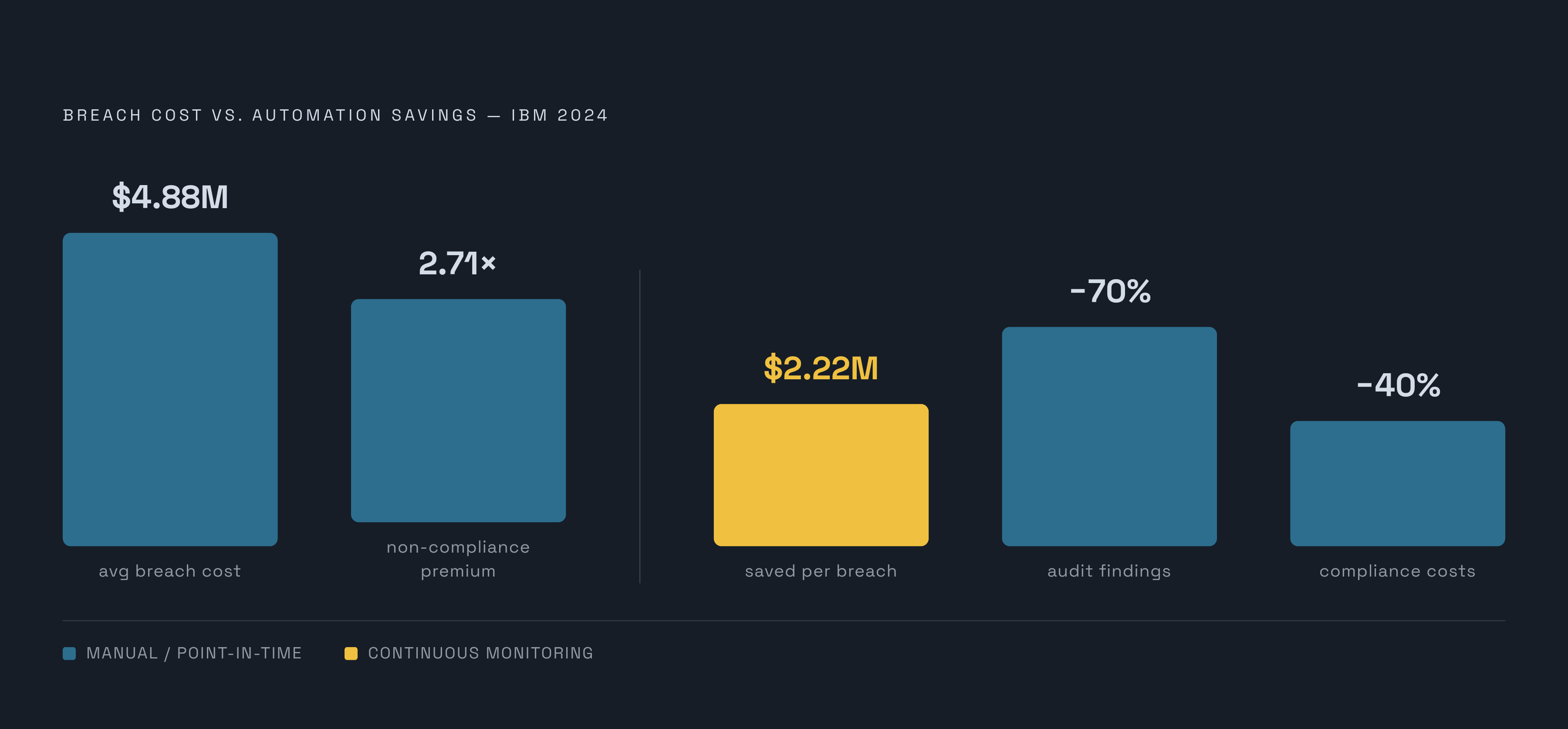
Money makes the argument concrete pretty fast. IBM's 2024 figures put the global average cost of a data breach at $4.88 million, and organizations running extensive security automation saved an average of $2.22 million per breach compared to those without it. Non-compliance itself carries a multiplier: once fines, legal costs, and remediation get totaled up, staying non-compliant costs roughly 2.71 times more than staying compliant in the first place. GDPR enforcement alone hit about EUR 1.2 billion in fines in 2025, pushing the cumulative total since 2018 to nearly EUR 5.88 billion.
On the return side, organizations that moved to continuous monitoring report audit findings dropping by 50 to 70%, audit effort dropping 60 to 80%, incident response speeding up by 60%, and compliance-related costs falling 40%. Arbour Education is a concrete case: after adopting automated evidence collection in May 2025, audit prep time dropped from six weeks down to two.
None of this is free, and pretending otherwise would be dishonest. Setup costs run high, especially for larger organizations with sprawling, tangled environments. Legacy systems are a real obstacle too: plenty of them simply don't expose APIs that support automated evidence pulls, no matter how much a vendor's sales deck promises otherwise. Staff need training, because continuous monitoring generates a steady stream of alerts that require triage, and without people trained to sort signal from noise, alert fatigue just replaces audit fatigue as the new burnout mechanism. Automation surfaces the issue. It does not resolve it, and it does not apply judgment, context, or common sense on its own, which is a documented failure mode worth taking seriously rather than waving away.
The pressure pushing companies toward continuous models anyway is structural: 72% of executives say growing compliance complexity has hurt their company's profitability. The manual, point-in-time model simply scales worse the more frameworks a company has to satisfy at once.
How to decide which model a specific control requires
One question does most of the work here: does the risk this control addresses operate continuously, or does it exist at a single point in time? Access permissions, encryption configuration, MFA enforcement, certificate validity, all of these can drift silently, which means continuous evidence isn't optional so much as structurally required. Policy approval, risk acceptance, contract execution: these are discrete acts, and point-in-time sampling covers them completely.
SOC 2 and PCI DSS increasingly expect proof that a control worked across a whole period, not just on the day someone happened to check. A single screenshot cannot satisfy period-of-time testing. Only continuous, timestamped evidence can, and no amount of polish on the screenshot changes that math.
For teams moving off the annual model, access management and vulnerability management are the obvious starting points: they eat the most audit prep hours and drift the fastest, which makes them the highest-leverage place to automate first. Partial, deep automation on a handful of high-velocity controls beats shallow, incomplete automation spread across everything. And the point-in-time artifact doesn't disappear in this transition, auditors still want that formal, dated report. What changes is where it comes from: instead of a manual sprint, it becomes a byproduct pulled from a year's worth of continuous operational data.
Mature programs end up running both models at once, deliberately: continuous monitoring as the operational layer, point-in-time sampling as the formal assurance layer sitting on top of it. The continuous data feeds the snapshot, and the snapshot stops having to pretend it accurately describes 365 days it never actually watched. Analysis of 2026 audit trends from CyberSierra puts continuous control monitoring on track to become the baseline expectation rather than a leading-edge practice by then, which means teams still treating it as optional are quietly accumulating technical debt against a requirement that's coming whether they've budgeted for it or not.
How platforms and tooling support the combined model today
The GRC platform market is already reorganizing around this. Archer extended its Archer Evolv product with continuous controls monitoring capability in November 2025, which is a fairly clear signal about where established vendors think the category is headed. RegScale, separately, has positioned itself across multiple compliance automation use cases, pointing at continuous compliance automation as the through-line.
FedRAMP 20x Phase 2's high automated validation threshold makes this less of a theoretical preference and more of a market entry requirement: vendors working in federal markets need scanning, evidence collection, and control mapping automated well before day one, not bolted on afterward.
What actually matters when evaluating a continuous evidence platform comes down to a short list. Native integrations with cloud infrastructure, IAM systems, and SIEM tools, so evidence gets pulled straight from the source rather than typed in manually. Framework crosswalk capability, since 80 to 90% control reuse across standards is what actually keeps a multi-framework program from becoming unmanageable. Drift alerting that maps a flagged change to the specific control and framework requirement it affects, not just a generic "something changed" notice sitting in an inbox. And audit-ready output: the platform needs to produce the formal, dated artifacts auditors actually require, not just an internal dashboard that looks impressive in a demo.
None of that works, though, if the control architecture underneath is muddled. A platform that surfaces alerts with no clear mapping to an organization's actual risk profile and audit scope just generates noise, and noise dressed up as data is arguably worse than no data at all, since it trains people to start ignoring the alerts altogether. The tooling is only ever as good as the thinking that decided what it should be watching in the first place, which is really the same lesson this entire piece keeps circling: pick the model that matches the question being asked, and the tools will follow. Get that backwards, and no amount of automation fixes it.
Methodology & sources
- Continuous Compliance vs Point-in-Time Audits: Which One Actually Keeps You Secure?
Provided IBM breach cost figures, non-compliance cost multiplier, GDPR fine totals, and executive survey data on compliance complexity.
- Continuous Compliance vs Point-in-Time Audits: Which One Actually Keeps You Secure?
Provided the figure on average savings per breach for organizations using extensive security automation.
- Top Audit Trends for 2026 Every CISO Should Know
Provided analysis projecting continuous control monitoring to become a baseline audit expectation by 2026.
- Why Continuous Monitoring Beats Point-in-Time Audits
Provided the statistic that 73% of security incidents occur outside the audit window, and the 40% compliance cost reduction figure.
- Why Continuous Monitoring is Replacing Point-in-Time Audits for Compliance
Provided the figure of 60 to 80% reduction in audit effort reported by organizations adopting continuous monitoring.
- Audit Evidence: Automation vs Manual
Provided the figure that automation platforms allow 80 to 90% of controls to be reused across compliance standards.
- https://cybersierra.co/blog/comparing-security-assessments/
Provided the figure that manual audit preparation typically exceeds 200 hours per cycle.