Managing Evidence for Automated Controls in CI/CD Pipelines
Automate evidence generation in your pipeline instead of scrambling before audits.
- Written by
- Compliance Primer Editors
- Updated
- October 20, 2026
- Reading time
- 12 min read
- Sources cited
- 4 sources ↓
What this covers
Manual evidence collection is the wrong model for compliance in a world where code ships hourly, and clinging to it is the single most expensive mistake a compliance program can make. The fix isn't complicated: treat the CI/CD pipeline itself as the system of record, generating audit evidence as a byproduct of normal builds, gates, and deployments rather than as a separate scramble before an audit window opens. Most programs still get this backwards, and it costs them.
Anyone who's worked a delivery freeze the week before an audit knows the drill: screenshots pulled from dashboards, spreadsheets stitched together from disparate tools, teammates chased down to explain a change they made two months ago. Per Hyperproof's 2025 data, roughly half of compliance professionals spend 30 to 50 percent of their working time on this kind of manual evidence collection, time that isn't going toward analysis, remediation, or actually shipping software. The pattern persists because compliance and DevOps run on different clocks entirely: pipelines ship daily or hourly, while audit prep is built around a quarterly or annual snapshot, and those two rhythms don't reconcile on their own. RegScale's August 2025 research put a number on the resulting drag: disjointed tooling across security, IT, and DevOps can burn over 200 hours per quarter just embedding Compliance-as-Code into a pipeline. Audit readiness isn't a workstream you staff up before a deadline. It's a property of how the delivery path is built, and treating it as anything else guarantees the same fire drill next quarter.
What it means for the pipeline to be the evidence-generation system
Evidence that's a byproduct of delivery is a different animal from evidence that's a downstream artifact somebody has to go collect after the fact. A pipeline built for the first case produces a record at every stage without anyone asking it to. Most compliance programs still don't build for that, and it's the whole argument.
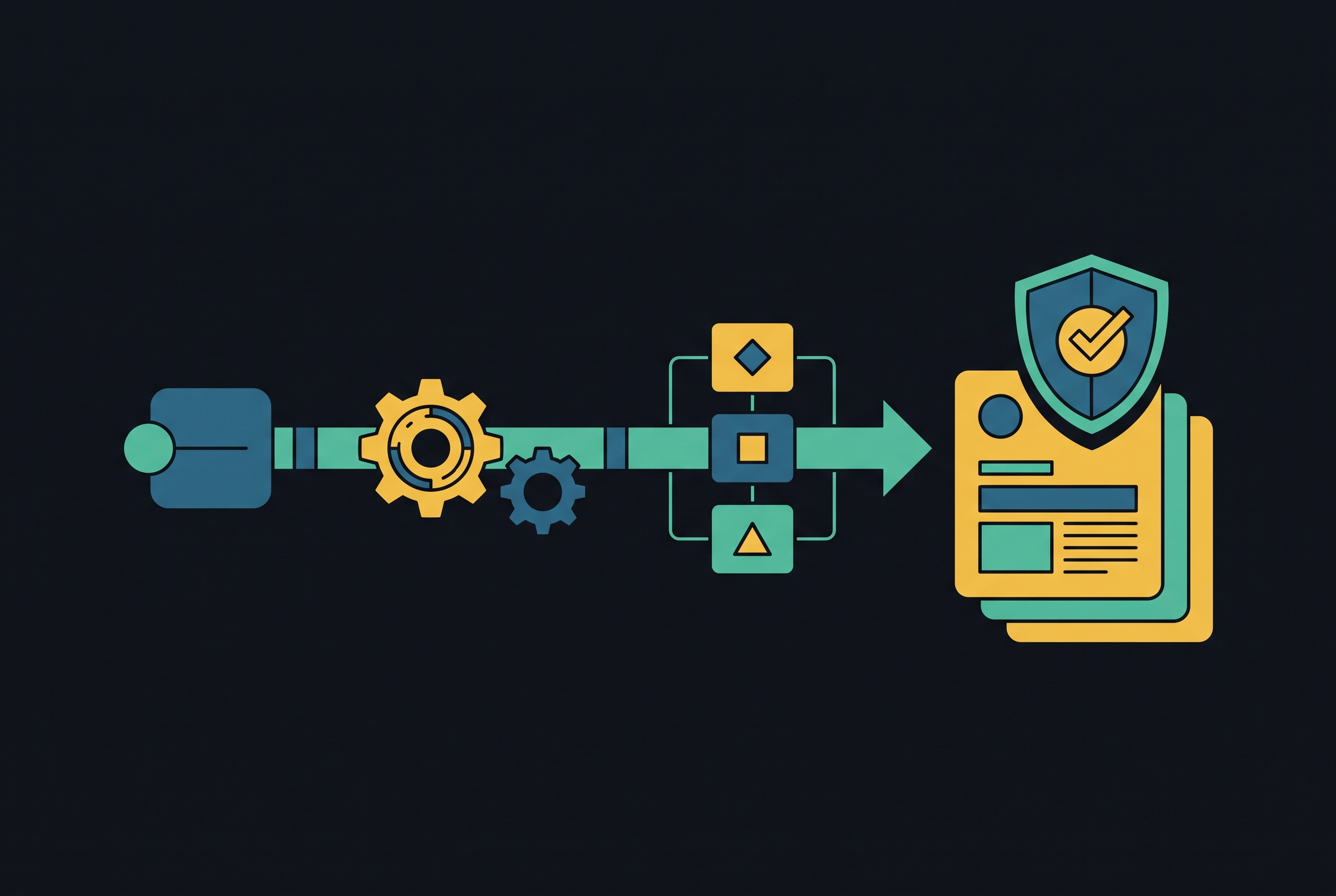
Code commits carry identity, a timestamp, and a business justification. PR approvals leave an authorization chain: who reviewed, who approved, and when. Pipeline runs generate tamper-evident logs, artifact identifiers, and clear pass or fail outcomes. Deploy records tie a forensic-grade change history to the exact artifact that shipped. RBAC changes log who touched access, when, and under what authorization.
None of that matters if the records can be quietly edited later. Cryptographic verifiability, meaning artifact signatures and pipeline logs that can't be retroactively altered, is what turns a log into evidence rather than a claim. Charity Majors, writing on the Buildkite blog, put it directly: "The way you build accountability into software is by designing it into the architecture of your CI/CD pipeline, and pairing on code reviews. It's in your checksums, your fingerprints, your static application security testing... your auditable, replayable software pipeline." Get that right, and an audit stops being an act of reconstruction. It becomes an act of retrieval. The organizing tool for that retrieval is a control-to-evidence matrix, which maps every control the organization is accountable for to a specific pipeline output, so gaps in coverage show up long before an auditor finds them.
Policy-as-Code as the mechanism that closes the gap between intent and enforcement
Policy-as-Code takes regulatory rules and internal governance requirements and turns them into executable code that runs inside the pipeline, not as a side process bolted onto it. Most teams get the sequence backwards. They write the policy document first and treat automation as an afterthought that enforces what the document already said. That order is wrong, and it should be flipped: the document becomes the byproduct, generated from what the code already enforces rather than the other way around.
A policy check that runs in the pipeline leaves behind a machine-generated, timestamped record that the check happened and what it found. A human saying "yes, we checked that" is not the same kind of evidence, and auditors know it. Tools like Open Policy Agent (with its Rego language), Cedar, and Sentinel are the common building blocks here, referenced in the AI-augmented CI/CD architecture work by Baqar et al. (arXiv, 2508.11867). Codified policy enforces the same way in dev, staging, and production: no environment quietly skips the rule, and no single reviewer becomes the point of failure everyone depends on. It's also fast. Automated policy checks run inside the same pipeline execution that triggers the build, returning results far faster than manual review cycles allow.
There's a real tension underneath this: teams want the freedom to use different toolchains, but the organization still needs non-negotiable baselines enforced everywhere. Policy-as-Code is the layer that bridges that gap, letting teams pick their own tools while the policy engine holds the line on what actually has to be true. It doesn't erase the old friction between compliance and DevOps teams, but it gives both sides a shared, inspectable artifact, the policy code itself, to argue about instead of arguing past each other.
How gates, warnings, and exceptions shape the evidence record
Not every risk deserves a hard stop. Teams that gate on everything aren't safer for it. They're worse off, because engineers learn to click through every signal the pipeline throws at them, important ones included. CloudAware's guidance on this is blunt: gates for high-impact, high-confidence risk, warnings for everything else. Anything broader trains people to route around the pipeline entirely, and that's the real cost of over-gating.
A pipeline that blocks indiscriminately teaches people to find workarounds, and workarounds leave behind exactly the kind of evidence an auditor doesn't want to see: a record of a control that was bypassed rather than satisfied. That's worse than no record at all, because now there's a paper trail proving the failure.
Exceptions are where this gets sharp. An exception without an owner, a defined scope, and a closure date isn't a managed risk decision. It's bypass debt quietly accumulating, and an open-ended exception is itself a finding waiting for someone to notice it. Well-designed gates solve for this by producing three distinct evidence types automatically: a blocked gate leaves a dated, system-generated record of what failed and why; a passed gate leaves a dated attestation that the control was satisfied; a managed exception leaves a record of who approved it, on what basis, and when it's set to close. The warning tier does something quieter but still valuable, producing a compliance data point that shows the team was informed of a specific risk and made a documented choice to proceed anyway. That's auditable context, even without a block.
The SLSA framework gives a concrete shape to what "good" gate output looks like. Signed metadata and immutable build history are associated with the SLSA build track, and two-person review was a Source-track Level 4 requirement (a mandate that was adjusted in the SLSA v1.0 build track). These aren't extra paperwork sitting next to the pipeline. They're outputs the gate itself produces.
The compliance data architecture that makes evidence queryable over time
Pipeline evidence is only useful if someone can find it a year later and prove it hasn't been touched. That's the argument behind what's being called a Compliance Data Lakehouse: treat pipeline artifacts as a time-indexed, queryable compliance data product, not a flat pile of logs sitting in cold storage.
The problem it solves is real, and it isn't hypothetical. CSPM tools, security platforms, custom scripts, and log analytics systems all generate evidence in their own formats. Without something normalizing all of that, an auditor is still stuck doing reconstruction work, just with more raw material to sort through. That's arguably worse than having less of it.
GitLab has published a concrete version of this architecture worth studying. It integrates custom scripts, CSPM tools, security platforms, and log analytics into a centralized evidence repository, and runs a dual testing framework on top: framework-based testing through a Requirements Coverage Matrix mapped to ISO, SOC 2, and other certifications, and risk-based testing through the GitLab Control Framework, which handles risk categorization and scoping. The output is framework compliance reporting, risk-based analysis, and a consolidated metrics dashboard.
The evidence library sitting underneath this is the part that actually saves work. Each piece of evidence gets tagged to a control, a framework, and a time period, so the same artifact can satisfy SOC 2 and ISO 27001 at once without being collected twice. Integrity controls that prevent retroactive alteration are what make this trustworthy rather than just organized, a distinction that matters the moment a regulator asks whether the logs could have been altered after the fact. The bigger shift is from point-in-time audit to continuous assurance: compliance posture becomes something visible in real time, not something calculated the week before an audit and then set aside for another year.
How regulatory frameworks are moving toward machine-readable evidence requirements
SOC 2 already assumes this kind of connected evidence. A modern SOC 2 platform auto-maps controls to the Common Criteria (CC1.x through CC9.x) and the Trust Service Criteria, security, availability, processing integrity, confidentiality, and privacy, then pulls evidence straight from connected systems. The CI/CD pipeline is one of those connected systems, whether an organization has deliberately wired it in or not.
FedRAMP 20x is the clearer signal of where things are headed. Announced in March 2025 as a pilot program, it reimagines FedRAMP's authorization process by replacing the traditional NIST 800-53 control-by-control documentation model with Key Security Indicators, which stay mapped back to the underlying 800-53 controls rather than discarding them. It leans hard on automated, machine-readable evidence alongside human-readable documentation rather than replacing it outright, and Phase 2 of the program requires both formats to be present together. It also pushes toward continuous reporting and authorization instead of a point-in-time assessment. What it's replacing is genuinely burdensome: a FedRAMP Rev 5 System Security Plan often runs 800 to 1,000-plus pages, and 20x is a direct response to that weight, according to an arXiv preprint (2510.09613).
The direction is consistent across frameworks, and it only points one way: regulators want outputs a system generated, not documents a human assembled after the fact. Pipeline-native evidence already looks like the format regulation is moving toward, rather than something bolted on to satisfy an older standard. The financial stakes for getting this wrong keep climbing too. Regulatory penalties across major frameworks can be substantial, and that's before counting what happens when a compliance gap turns into an actual breach. IBM's 2025 Cost of a Data Breach report puts the global average breach cost around $4.44 million, with the U.S. average closer to $10.22 million, figures cited via Konfirmity. Manual compliance gaps aren't just an audit-prep cost anymore.
Where automated evidence collection still fails auditors
Automation isn't the same thing as compliance, and treating it that way is the single biggest trap in this whole shift. A documented obstacle to Compliance-as-Code adoption is that teams assume that because the pipeline is instrumented, coverage is complete. It usually isn't, and the gaps that remain are precisely the ones auditors are trained to find.
A recurring auditor finding is customer PII sitting in systems that were never designed to hold it: collaboration tools, ticketing systems, and plain email. Pipeline evidence collection that only watches code and build artifacts never sees any of that, because it isn't looking there in the first place.
Access reviews are the second recurring gap. A review process can technically "happen" and still leave no usable trail: no record of who actually reviewed what, or worse, a stack of rubber-stamp approvals with no reasoning attached to any of them. That isn't evidence. It's a paper trail with nothing behind it.
The third gap is newer and growing fast: staff pasting customer data into ChatGPT, Claude, or Copilot to summarize a support ticket or draft a response. That's a live exposure category, and pipeline automation doesn't catch it unless an organization has built explicit controls and evidence collection specifically around AI tool usage. It's a policy gap, not a tooling gap, and no amount of pipeline instrumentation fixes a policy gap.
AI inside the pipeline itself raises a related, sharper problem. When AI agents start making autonomous decisions in the build or deploy path, Baqar et al. (arXiv, 2508.11867) flag concerns that don't go away just because the agent is fast and consistent, including data security, auditability, human-in-the-loop control, and explainability of outcomes. Build artifacts, test logs, and deployment configs need to be redacted or masked before they're handed to a model for processing. Unmasked data that reaches an external model is itself a gap in the evidence record, not a shortcut around one. Evidence coverage has to match where data actually flows and where the real attack surface sits, not just the parts of the system the pipeline already happens to instrument.
Designing the control-to-evidence matrix as an operational practice
The control-to-evidence matrix is what turns all of this into something an organization can actually run, not just describe. It maps every control the organization is accountable for to the specific pipeline output that satisfies it, which is what makes coverage gaps visible before an auditor finds them for you.
Building it starts with the framework's control list: SOC 2's CC criteria, FedRAMP's KSIs, ISO 27001's clauses, whatever applies. For each control, the matrix needs four answers: which pipeline stage enforces it, what artifact that stage produces, where the artifact is stored, and how long it has to be retained. Any control that comes up with no pipeline output attached is a real manual gap, not a rounding error to note and move past. It needs either new instrumentation or an honest, documented exception. Pretending the gap doesn't exist isn't an option worth entertaining.
The matrix is the index; the evidence library described earlier is the store. Together, they turn an audit into a lookup exercise instead of a research project. Because the same pipeline artifact can often satisfy controls across SOC 2, ISO 27001, and FedRAMP at once, a well-built matrix directly cuts duplicate collection work, not just duplicate paperwork. It also has to stay alive: a policy change or a new regulatory requirement should trigger a matrix review, not a fire drill six weeks before the next audit. RegScale's August 2025 research frames the payoff in blunt terms: automation saves roughly 80 percent of the effort and cost of onboarding a new compliance framework manually. A matrix that's actually kept current is what makes that number real. A matrix left stale is what makes it worthless.
What measurably changes when pipeline evidence replaces manual collection

Go back to where this started: roughly half of compliance professionals spend 30 to 50 percent of their time on manual evidence collection, per Hyperproof's 2025 data. That's the baseline this whole approach is built to replace, and no serious engineering organization should tolerate it once the alternative exists.
The efficiency numbers back it up from multiple angles. RegScale's August 2025 research puts automated compliance at roughly 60 percent less expensive than manual audits. Konfirmity's January 2026 research found that combining automation with structured evidence templates compresses readiness timelines from around nine months down to four, while saving hundreds of hours and lowering the odds of a finding. Vanta reports users saving roughly 50 hours a month on ongoing compliance work, and that's a recurring saving, month after month, not a one-time cleanup.
The quality argument matters just as much as the speed argument. Pipeline-generated evidence is cryptographically verifiable and system-generated, which makes it a much harder thing for an auditor to poke holes in than a spreadsheet somebody put together the week before the review.
None of this removes the need for governance, and pretending otherwise is its own failure mode. Human review of AI-driven pipeline decisions still matters, and the data flows a pipeline doesn't naturally touch, PII sitting in Slack, unreviewed access changes, staff pasting customer data into an AI chat window, still need explicit controls built around them on purpose. Automation narrows the manual-collection problem. It doesn't erase the governance problem sitting next to it.
What does change, for good, is the question teams ask themselves. Organizations that treat the delivery path as the compliance record stop asking whether they're ready for the next audit. The pipeline already knows the answer, and it knows it continuously, not once a quarter.
Methodology & sources
- Exploring Continuous Compliance Automation in 2025
Provided the figures on hours burned by disjointed tooling, the 80 percent effort savings from automation, and the 60 percent cost reduction versus manual audits.
- Practicing continuous compliance and governance in CI/CD.
Supplied the Charity Majors quotation on designing accountability into CI/CD pipeline architecture.
- DevSecOps Compliance: CI/CD Controls, Evidence, and SOC 2
Provided the guidance on gating strategy — hard blocks for high-impact risk, warnings for everything else.
- AI-Augmented CI/CD Pipelines: From Code Commit to Production with Autonomous Decisions
Cited for the Policy-as-Code tooling discussion (OPA, Cedar, Sentinel) and for concerns about AI agents making autonomous pipeline decisions.