SOC 2 Risk Assessment Requirements and Documentation Standards
How SOC 2 risk assessments tie threats to auditable controls.
- Written by
- Compliance Primer Editors
- Published
- November 24, 2026
- Reading time
- 8 min read
- Sources cited
- 6 sources ↓
What this covers
A SOC 2 risk assessment connects an organization’s real-world threats to the controls auditors test. Its requirements and documentation standards make sense only when treated as one system. A defensible assessment establishes what needs protection, explains the controls chosen, and produces the evidence trail that supports the audit.
Why SOC 2 is built around risk assessment, not around controls
Many teams treat the risk assessment as one artifact among many, filed beside policies and evidence. That reverses the relationship between risk and control. SOC 2 is an attestation framework developed by the AICPA. It tests whether a service organization’s controls meet the relevant Trust Services Criteria, while the required written assessment sets out which controls the organization needs.
Those criteria cover Security, Availability, Processing Integrity, Confidentiality, and Privacy. Security is mandatory in every engagement. The remaining four enter scope according to the organization’s services and buyer demands. The operative standard in 2026 remains the 2017 Trust Services Criteria with revised Points of Focus published in October 2022. The AICPA released an exposure draft in October 2026 with an expected 2027 release, but no new final version has replaced the standard. The immediate shift is in auditor scrutiny of AI systems, vendor contracts, and evidence quality.
The criteria that require a risk assessment and what each one demands
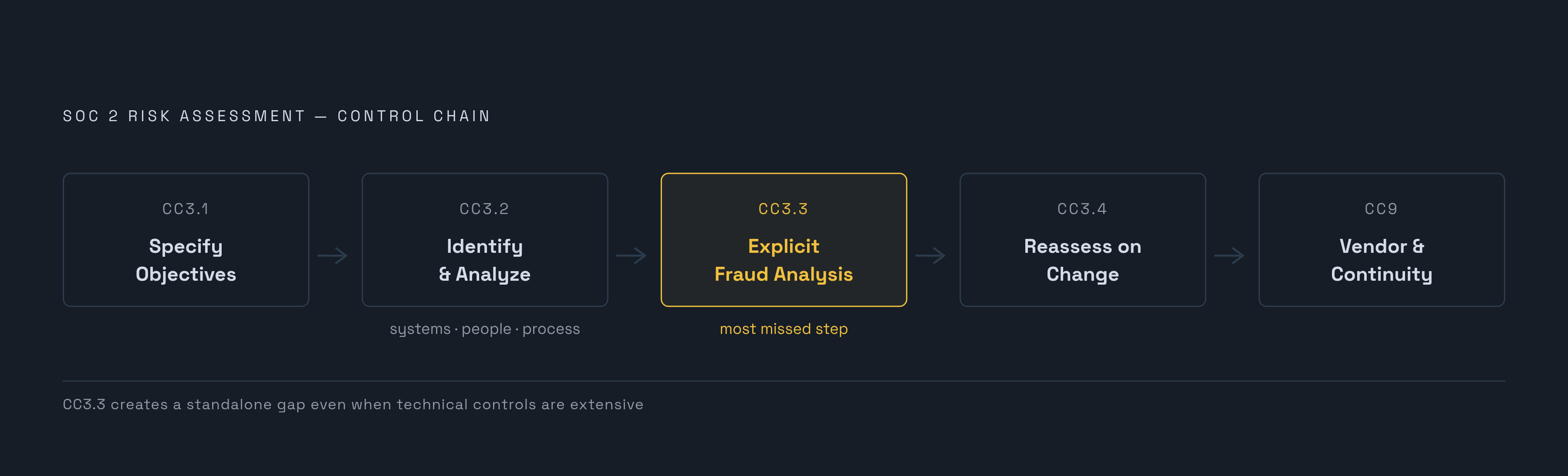
The CC3 series establishes the risk assessment requirement, and CC9 connects it to risk mitigation. CC3.1 requires clearly specified objectives so that the organization can identify risks to achieving them. CC3.2 then requires the organization to identify and analyze risks across its scoped systems, people, and processes. Together, these criteria establish both the purpose and breadth of the assessment.
CC3.3 makes fraud an explicit part of that analysis, rather than something assumed to fall within general security risk. CC3.4 requires reassessment when significant changes occur. Neither requirement is satisfied by a generic threat inventory. An assessment can identify technical vulnerabilities yet omit fraud, or describe current risks without showing how changes trigger another review. Those omissions leave gaps in the assessment even when the organization has extensive technical controls.
CC9 extends the analysis into continuity and dependencies. A provider’s role in delivering the service belongs in the same analysis as internal operational risks.
The first five Common Criteria series, CC1–CC5, follow COSO’s internal-control principles, so documents already used for a financial audit may support areas such as board oversight and a code of conduct. The Common Criteria have 33 criteria, with CC6 covering logical and physical access, CC7 system operations, and CC8 change management. Auditors use assessment findings to determine where substantive evidence is most needed across that structure. Risk assessment therefore extends beyond CC3 throughout the framework.
What scope the risk assessment must actually cover
An infrastructure-only assessment cannot establish the full risk picture. The required scope includes strategic, operational, financial, and technical risks across technology, people, and processes. A vulnerable dependency is a technical risk, while a former employee who still has database access because offboarding was incomplete is a process-related risk. Both can affect the same service, but they come from different failures. Restricting participation to IT can also leave the fraud requirement in CC3.3 unaddressed.
Engineering, product, legal, HR, and finance contribute to identifying the range of risks required by CC3.2. Its purpose is to expose risks that would otherwise remain outside the assessment, even though they affect the organization’s objectives. The resulting scope must reflect how the service operates, rather than the boundaries of the team preparing the document.
Contractual obligations and service levels set the first limits on scope. They determine which Trust Services Criteria apply, which systems and data flows belong in scope, and which third-party providers require assessment. The documents that define scope include data-flow diagrams, provider lists, and service-commitment statements. For a SaaS platform processing personal data for EU customers, Privacy and GDPR-specific controls become relevant, while uptime guarantees require Availability. An assessment that documents an on-premises data center but omits the cloud environment running the product fails on completeness, regardless of its presentation.
The minimum documentation set auditors require
The risk register records the assessment at the level of individual risks. Each entry includes likelihood and impact scores, inherent and residual risk ratings, mapped controls, a treatment plan, an owner, and current status. It is the program’s single source of truth. Because the register also shows how risks are being managed, an outdated version can lead to a finding or qualified opinion.
The written assessment report turns those entries into an account of scope, methodology, findings, and mitigation plans. Leadership sign-off documents review of that account. Evidence of regular reporting to leadership then shows that oversight continues after the report is approved. These records serve different purposes, so an approved report does not replace the underlying register or the record of subsequent reviews.
Risk acceptance requires its own documented procedure, including who may approve accepted risks and at what authority level. Each accepted risk needs a written reason and evidence of senior-management review. Each risk must also have an owner who is named. A generic assignment to “the security team” does not establish the accountability auditors expect for an identified risk. The acceptance record explains a decision, while the owner assignment establishes who is responsible for managing it.
The control mapping matrix translates the assessment’s findings and treatment plans into an auditable trail. It links each policy and procedure to the relevant Trust Services Criterion and points to supporting evidence, such as access logs or provisioning records. Auditors can then trace the relationship without reconstructing it manually. The system description anchors that mapping in a narrative of infrastructure, networks, services, data flows, and in-scope technologies. It establishes the audit boundary and ties the assessment back to the criteria, so the documentation set describes one coherent program.
Why annual documentation alone no longer satisfies auditor expectations
The annual minimum does not resolve the question of ongoing management. Auditor practice now expects continuous monitoring and evidence of regular reassessment. For Type II reports, auditors sample evidence from the whole observation window, which is usually six to twelve months. A register showing activity only at the beginning and end does not demonstrate management throughout that period.
CC3.4 gives that expectation a specific operational basis. A significant operational, technical, or vendor change during the observation window should produce a documented reassessment event when the change occurs. An annual assessment may meet the minimum for scheduled reviews without showing that the organization acted when a risk changed. This distinction makes reassessment records part of the evidence program.
Evidence quality is changing with that expectation. Static screenshots increasingly face challenges because they show a point in time, while continuous-monitoring exports with timestamps can demonstrate control operation across the audit window. Automation platforms help with this work by pulling evidence from cloud infrastructure, identity providers, and code repositories. No regulation currently mandates automation. Its practical value lies in maintaining evidence continuity, while the assessment itself remains a separate task.
That boundary is easy to overlook after integrations are connected. A platform does not write the access review policy, define the change management process, or identify the fraud risks required by CC3.3. Those tasks still require organizational judgment. Treating collected evidence as proof of a complete assessment leaves a gap between what the platform records and what the organization has considered.
Where the risk assessment must go further in 2026: AI systems, shadow tools, and vendor dependency
Auditors are examining AI systems, model vendors, and shadow AI through risk assessment, access control, system operations, and vendor-management requirements. These are applications of the existing framework. An organization using AI must assess the risks of that use to its stated objectives. An entry on technology risk in general gives too little detail about those risks.
For an assessment to reflect that use, AI-specific threats should be named explicitly. They include staff routing sensitive data through public tools and over-reliance on inaccurate model output. Approved-tool inventories alone do not establish the actual boundary. Documented situations include assessments listing approved AI tools while testing reveals employees sending confidential client data through consumer AI products without a data processing agreement. The discrepancy is a scope failure, because the assessment covers only approved use, leaving the exposure testing reveals outside its scope.
Shadow AI also differs structurally from shadow SaaS. Its data flows are harder to detect, its tools are more capable, and a PII exposure through an unapproved model can have a larger blast radius. Under CC9, the analysis must also cover vendor dependency. Supply chain events can eliminate a tool entirely rather than merely increase its price, bringing continuity of the dependency into the assessment. A model provider therefore requires evaluation in relation to the service that depends on it.
The evidence requests reflect those distinct risks. Auditors are requesting model registries with version and approval histories, prompt and inference logs with PII redaction, and tested rollback procedures. They also ask for LLM risk assessments for each provider, drift-monitoring output, and records of who is accountable for privileged actions taken by autonomous agents. The deployment model determines the relevant evidence. The AICPA’s June 2026 Annual Practice Questionnaire introduced annual reporting for enrolled A&A firms, leaving peer review standards unchanged. That distinction limits what the event establishes, but the broader scrutiny reinforces why identical TSC mappings across different AI deployments are insufficient.
What a qualified opinion costs and why the risk assessment is the first line of defense
A qualified opinion can cost enterprise deals even after an audit is completed. Procurement teams read the report. When an assessment misses a threat, the corresponding control is likely to be missing too, creating a gap auditors can flag and buyers can see. Most enterprise procurement processes for SaaS, cloud, and managed services now treat SOC 2 Type II as a baseline requirement. Without it, a provider can be screened out before technical evaluation begins.
Compliance debt comes to light when a buyer asks for the latest Type II report at renewal. The defense is a complete cross-functional assessment, a live register with named owners and treatment plans, quarterly leadership reporting, and continuous evidence collection across the audit window. Generic statements about vendor evaluation or model use do not meet that standard. Names of the people responsible, approvals with dates, and evidence that controls actually operated back up those statements.
The same documentation supports detailed procurement responses because assets, vulnerabilities, and mapped controls have already been catalogued. Compliance platforms can support evidence collection and register maintenance without replacing the judgment behind them. The assessment is both required and generative. It produces the control set, feeds the evidence program, and determines the shape of the audit. That structural role makes it the foundation of SOC 2.
Methodology & sources
- SOC 2 Compliance Requirements: The Full List of Criteria for 2026
Supplied the structure of the Common Criteria, including the count of criteria and the CC6-CC8 areas.
- SOC 2 Compliance Guide: 2026 Requirements & AI Controls
Informed the discussion of 2026 AI-related controls and the scope of auditor scrutiny over AI systems and vendors.
- SOC 2 risk assessment: A complete step-by-step guide
Provided the step-by-step risk assessment content: scope, risk register fields, risk acceptance, and documentation set.
- SOC 2 common criteria: What each CC control actually requires
Explained what the CC3 and CC9 criteria require, including fraud risk and reassessment on significant change.
- SOC 2 compliance requirements [2026 guide]
Contributed general requirements context on Trust Services Criteria, evidence collection, and the role of automation platforms.
- SOC 2 and AI in 2026: The Criteria Didn't Change, but the Examination Did - Weinlander Fitzhugh
Source for the point that criteria are unchanged while auditors examine AI systems, shadow AI, and evidence more closely.