Security Awareness Training Completion Evidence for Compliance Audits
Compliance auditors now demand proof of behavioral change, not just training completion rates.

- Written by
- Compliance Primer EditorsEditorial team
- Published
- October 11, 2026
- Reading time
- 10 min read
What this covers
An auditor sets down a completion report showing 95% of staff finished the annual training module, and then asks for something the report cannot answer: can a single employee in that 95% actually recognize a spear-phishing email when one lands in their inbox. That question, not the completion percentage, is now the test. A number on a dashboard says who clicked through a course. It says nothing about what they learned, whether the right people were even counted, or whether anyone with authority looked at the results and acted. Auditors across major compliance frameworks have absorbed this gap and shifted what they ask for, from participation toward program design, population coverage, and behavioral outcomes. NIS2, enforceable since October 18, 2024, with several member states still finishing national transposition into 2025 and 2026, pushes the same logic further by requiring management bodies themselves to sit through training, with personal liability attached. Accountability now traces to named individuals, not just an aggregate rate on a slide.
The evidence package auditors require
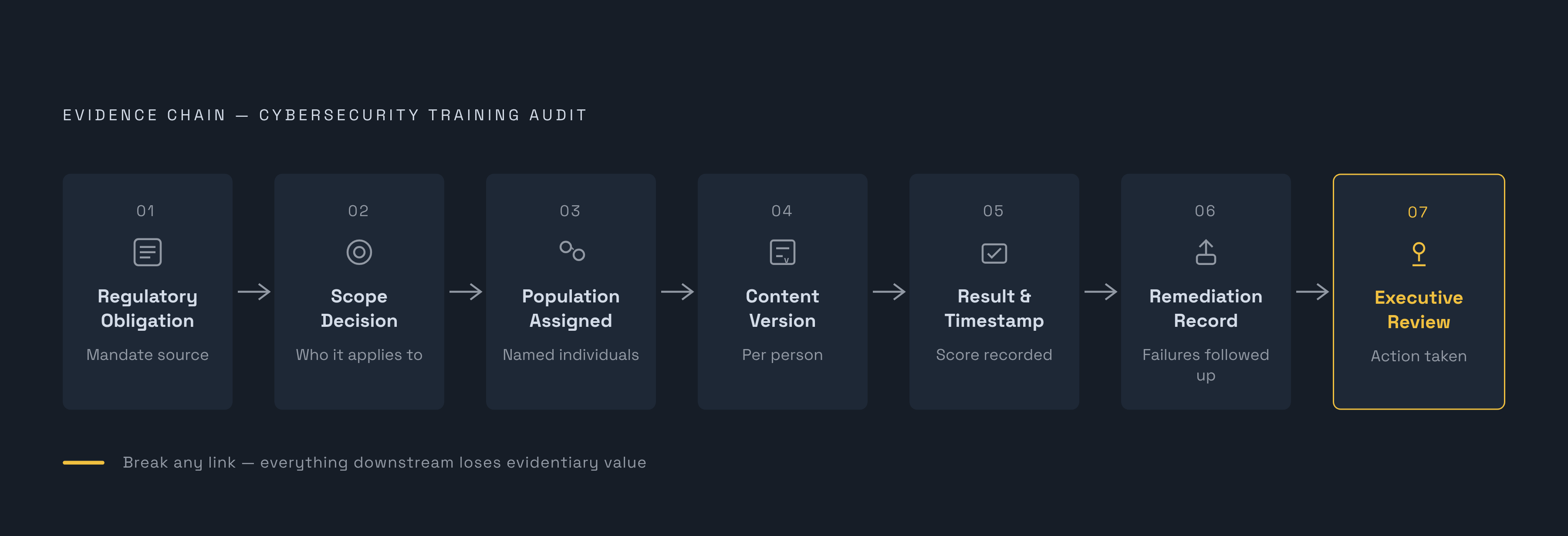
A defensible audit package is a chain, with each link depending on the one before it: the regulatory obligation, the decision about who it applies to, the population actually assigned, the version of the content they received, each person's individual result, what happened when that result was a failure, and proof that someone with authority reviewed the whole program and acted on what they saw. Break any link, and everything downstream of it loses its evidentiary value, no matter how clean it looks on its own. Auditors across frameworks tend to ask for seven categories of artifact built on that chain: a written, versioned, approved training policy with a named owner, a stated scope, a set frequency, and a defined consequence for non-completion; a population roster proving every in-scope person was assigned; per-employee completion records carrying timestamps, course version, and assessment scores rather than a rolled-up percentage; signed and stored policy acknowledgment forms; phishing simulation reports with dates, per-campaign click and report rates, and a trend line across the period under review; remediation records showing what happened when someone failed a simulation or missed a deadline; and documentation showing a manager or executive reviewed the program's performance and took action on it.
Most of this needs to exist before fieldwork starts, not after the request comes in. The chain also has to hold across the entire period under review, not just at the moment the auditor walks in. Weak training content rarely sinks an audit on its own. A broken evidence chain does.
Population scope as the first thing auditors test
Before an auditor looks at a single completion record, the first thing tested is the population the training program claims to cover, because an employee with system access who was never assigned training represents a control failure no matter how high the completion rate looks for everyone else. SOC 2 auditors specifically look for contractors, interns, and board members who hold system access, and these groups belong inside the documented training scope even when they never appear on an HR payroll roster. NIST SP 800-50 Rev 1, published in September 2024, pushed this perimeter outward again by pulling supply-chain participants into the obligation, so vendors and contractors with access to organizational systems now fall inside the same awareness-training requirement as internal staff.
The population also isn't flat. A single generic course assigned uniformly to everyone does not satisfy either control. None of this scoping happens by accident, and auditors expect the decision itself to be written down: not just who was trained, but how the organization decided who needed to be in scope in the first place. The gaps that show up most often in fieldwork follow a predictable shape: a contractor with production access who was never assigned a module, an executive who got a waiver that was never put in writing, a new hire who finished onboarding before anyone created their training assignment.
Curriculum content documentation, versioning, and audience matching
What gets taught, to which audience, and in which version is itself something an auditor can sample. It is not a delivery detail left to whoever runs the training program. SOC 2 auditors require that the specific course version each person received be retained alongside their completion date and assessment score, and version control over training content is checked directly against the record in a Type 2 engagement. Alongside those records, a defensible program keeps per-employee certificates of completion, archived phishing simulation reports with dates and results, and signed, stored policy acknowledgment forms.
Across frameworks, the subject matter itself tends to converge on the same list: phishing and spear-phishing recognition, business email compromise, vishing, smishing, deepfake impersonation, credential protection, data handling, and incident reporting. PCI DSS v4.0 Requirement 5.4.1 goes a step further by making phishing simulation itself a compliance-relevant control. Simulation records have to be kept as curriculum evidence, not treated solely as a behavioral metric collected on the side. A gap in version history across that transition reads to an auditor as a gap in the control itself, and it sets up the next problem directly: a curriculum can be perfectly current and still produce no proof that anyone's behavior actually changed.
Behavioral metrics as audit evidence
Behavioral outcomes, collected consistently, tracked over time, and tied to actual remediation decisions, separate a program an auditor can trust from one that only looks good on paper. NIST SP 800-50 Rev 1 explicitly moved its own scorecard away from activity metrics toward outcome metrics, naming phishing-failure trend, time-to-report, and repeat-clicker rate as the indicators that matter. A single phishing test with a good click rate proves little on its own. A downward trend across a full review period, paired with remediation records for the employees who kept clicking, is what an auditor can actually rely on.
The strongest objection to this approach deserves to be stated: completion records remain the only artifact that is cleanly auditable in the traditional sense, because a simulation's result depends on how hard the campaign was designed to be, how it was timed, and other variables that are harder to standardize than a course completion timestamp. Even so, ISO 27001 auditors and cyber insurers are increasingly treating behavioral data as proof that a program actually works, and a program with no trend data to show is getting harder to defend even in the absence of an explicit mandate requiring it. The empirical case for why completion alone falls short comes from research at a major health system, which found that employees who had just finished their annual training clicked on phishing simulations at roughly the same rate as employees who hadn't trained. That finding is the clearest evidence that a completion log, by itself, cannot answer the question an auditor is actually asking.
Evidence standards across SOC 2, ISO 27001, HIPAA, PCI DSS, and NIS2/DORA
Each framework sets its own evidentiary bar, and an organization answering to more than one of them needs to know where those bars overlap and where they pull apart, because a single program built to the strictest standard can usually satisfy all of them from one evidence base.
SOC 2, under CC2.2 and CC1.4, does not specify a course, a platform, a passing quiz score, a 30-day onboarding window, or a fixed annual training date. The organization defines its own control, and the auditor's job is to test whether that control was designed sensibly and operated without gaps. A Type 1 engagement checks whether the program was designed correctly at one point in time. A Type 2 engagement checks whether the control held up across the entire period under review, so completion timestamps need to be spread evenly throughout that window.
ISO 27001:2022, under A.6.3 and Clause 7.2, requires training records to be stored and accessible for at least the organization's last certification cycle, generally three years. Role-based content delivery is mandatory under Clause 7.2, so generic, one-size-fits-all training does not satisfy the control. The transition deadline to the 2022 version of the standard was October 31, 2025, so any organization audited now has to show A.6.3 compliance measured against the current standard, not the version it replaced.
HIPAA centers its evidence standard on policy, assignment records, and proof that training addresses the specific risks the organization identified in its own risk analysis.
NIS2 and DORA push the evidentiary standard into personal accountability. Article 20 of NIS2 requires management bodies to undergo cybersecurity training themselves and to encourage similar training for employees on a regular basis, turning awareness training into a legal obligation carrying personal liability for named executives. DORA, applicable from January 17, 2025, entered its first real supervisory enforcement cycle for financial entities in 2025 and 2026, and training program documentation is now something examiners actually look at. Under NIS2 enforcement, a management team's training attendance and acknowledgment records function as personal liability evidence, not just as a line item in a broader compliance report.
Mapped well, one program can serve every one of these frameworks from a single evidence package, as long as each activity inside it is tagged against every regulatory citation it touches. The underlying evidence stays unified. The tagging is what makes that same evidence legible to five different auditors asking five different questions.
The written policy document's required contents as an anchor for all other evidence
The written policy carries the rest of the evidence package on its back. Without it, completion records, simulation results, and acknowledgment forms have nothing to attach to, and an auditor has no way to judge whether the program ran the way it was supposed to. A policy capable of doing that job needs to state its purpose and scope, naming who it covers and which systems fall under it; name the roles responsible for it with identifiable owners; make clear, testable statements that can be checked against a sample of actual records; lay out a documented exceptions process with a named approver and an expiry date on each exception; describe monitoring and enforcement terms that match what actually happens; and carry a review cadence with its version history kept intact.
Frequency has to be stated outright, typically annual for the general workforce with more frequent sessions for higher-risk roles, because auditors check that stated frequency directly against the completion timestamps to see whether the two line up. The approval chain matters as much as the content: the document needs a version number, an approval date, and an identified approver attached to it, and a draft missing those fields is one of the most frequent findings in a first audit. Employee acknowledgment of the policy counts as its own separate artifact, distinct from training completion itself; SOC 2 and ISO 27001 both treat the two as different pieces of evidence. None of this holds up, though, if the policy says one thing and the records show another: if the document promises a follow-up within 14 days of a missed deadline, the remediation records have to show that follow-up actually happened, or the policy itself becomes evidence of a gap rather than proof the program worked. A named policy owner identified before audit season begins, rather than during it, is what keeps this document from becoming an unassigned item sitting open through fieldwork, a pattern auditors read as a sign of weak governance.
Documentation gaps that most often cause audit failures
Most audit failures in this space are documentation failures. The program ran, employees sat through the course, and the organization still cannot produce a clean, explainable record of it under fieldwork conditions, because the evidence chain has breaks somewhere along its length. A policy-practice mismatch, where the policy promises a 30-day onboarding deadline but a comparison of hire dates against completion dates shows a longer actual median, turns the policy itself into evidence against the organization. And a program with behavioral metrics on file but no documented review by a responsible executive or committee leaves an auditor with no proof that anyone with authority ever looked at the data and acted on it.
Running a mock PBC exercise, retrieving evidence for ten controls exactly as if an auditor had just requested them, reveals these retrieval failures in the evidence chain before they turn into actual findings. Fixing everything at once is rarely realistic, and it isn't necessary: identifying three priority gaps and assigning one owner to each, with a public due date attached, puts an organization in a stronger position for an audit than a program that looks comprehensive on paper but can't produce a single record on demand. Tools that bring policy publication, acknowledgment tracking, completion logging, and control mapping into one workflow close off the parallel spreadsheets where these gaps tend to build up quietly between review cycles. Platforms built specifically for this work, such as Adaptive Security, log every completion, score, and timestamp automatically and hold the evidence chain in a form auditors can sample directly. This cuts down on the retrieval failures and version-control problems that generate most audit exceptions. The evidence chain holds up best when it is produced continuously and generated by the system itself, not reconstructed by hand in the weeks before an auditor walks in.