Choosing a SOC 2 Auditor for a Series A SaaS Company
A wrong auditor choice at Series A can stall deals and burn months of runway.
SOC 2 sits at the center of enterprise SaaS sales now, and picking the wrong auditor at Series A can cost a company a quarter or more of runway in stalled deals. Enterprise buyers treat the report as a gate, not a nice-to-have, and the investor side has caught up to the same expectation. Five years ago, compliance rarely came up in Series A diligence. Now it's close to standard for any startup touching customer data, building AI products, or chasing enterprise logos, and an SRS Acquiom due diligence study found 84% of respondents expect more cybersecurity scrutiny over the next 12 to 24 months. Put sales gatekeeping and investor scrutiny together, and SOC 2 stops being a compliance checkbox: it becomes deal infrastructure, the thing that turns "we take security seriously" from a line on a pitch deck into an attested fact right when someone is pricing how mature the company actually is.
What is actually being audited, the framework a Series A company needs to understand before engaging anyone
SOC 2 is not a certification. There's no badge issued, no pass/fail stamp. It's an attestation engagement performed by a CPA firm enrolled in the AICPA peer review program. What comes out the other end is a report, that a customer's security team will actually read line by line.
The report is built around five Trust Services Criteria, defined in AICPA TSP Section 100, with the 2022 revised points of focus still the operative standard heading into 2026. Security is mandatory, full stop: it covers the baseline controls (access management, encryption, monitoring) that every other criterion depends on. Availability gets added mostly by companies whose uptime is part of the sales pitch. Processing Integrity, Confidentiality, and Privacy get added based on what the product actually promises and what specific customers demand in contract language.
Then there's the Type I versus Type II decision, and this is where most early-stage companies get it backwards. A Type I report says controls were designed appropriately at a single point in time, a snapshot. It's faster and cheaper, and it's also the wrong choice for almost any company with enterprise prospects already in the pipeline, because those buyers won't accept anything short of Type II. A Type II report says the controls actually operated effectively over a defined window, typically three to twelve months, and it's what the market has settled on as the real standard.
Two mistakes show up constantly at this stage. The first: leadership picks Type I because it's faster, without noticing the pipeline already has prospects who will demand Type II, so the company ends up running the whole process twice. The second, less obvious but just as costly, is pushing straight into Type II before the underlying controls have had time to stabilize. Auditors then find exceptions mid-period, remediation work piles up inside the observation window, and the credibility damage with both the auditor and the board outlasts the fix.
The right move is to start narrow. Scope Security only for the first audit, and add Availability or Confidentiality later, once a specific buyer asks for it in writing. Keeping the first audit tight keeps the whole program manageable, and it gives the internal team a chance to build real muscle memory before the scope expands.
Inside the report itself: a management assertion, a system description covering products, environments, data flows, third-party services, and the people running it all, a rundown of the control environment, the tests the auditor actually performed, and the results. That's the document a procurement team, or a Series A investor's diligence counsel, will sit down and read line by line.
Who is legally qualified to sign a SOC 2 report, and how to verify a firm before signing anything
Only a licensed CPA firm can issue a SOC 2 report. That's mandated under AICPA standards, specifically SSAE 18 and AT-C sections 105 and 205, not just a convention. Non-CPA professionals, security specialists, penetration testers, GRC consultants, can perform testing work as technical specialists on the engagement team. They cannot sign the final opinion, and any firm that suggests otherwise shouldn't be on the shortlist.
AICPA membership itself is voluntary, a trade association rather than a licensing body. The actual legal authority to issue a SOC 2 report comes from a state CPA license and enrollment in a peer review program, both of which exist independent of whether the firm belongs to the AICPA at all.
Peer review is the real quality gate, more useful as a filter than the firm's own marketing copy. CPA firms go through a periodic peer review, typically every three years, to confirm their internal quality control procedures actually meet AICPA professional standards. A clean peer review report is the floor for reliability, not the ceiling, so it's the first thing to check before signing anything.
Independence rules carry real teeth here. A CPA firm cannot hold any financial interest, direct or indirect, in the client it's auditing. It also cannot have designed or implemented the controls it's now hired to test: that's a self-review threat, and it's disqualifying under the standards, not a gray area worth negotiating. In practice, the firm that did readiness work, building the policies, standing up access reviews, cannot be the same firm that signs the audit opinion. They have to be separate entities, full stop.
The regulatory picture tightened at the end of 2025. AICPA's Professional Ethics Executive Committee released clarifying revisions to the Code of Professional Conduct specifically targeting SSAE-based engagements like SOC 2, according to AICPA guidance. The revisions, per that commentary, addressed concerns about how SSAE-based engagements are structured, exactly the setup a Series A company should be watching for.
Before signing an engagement letter with any firm, confirm the state CPA license, pull its record from the AICPA Peer Review Public File, and scan for red flags like prior financial ties or advisory work on the exact controls now up for audit.
How the auditor market breaks into tiers, and which tier fits a Series A SaaS company
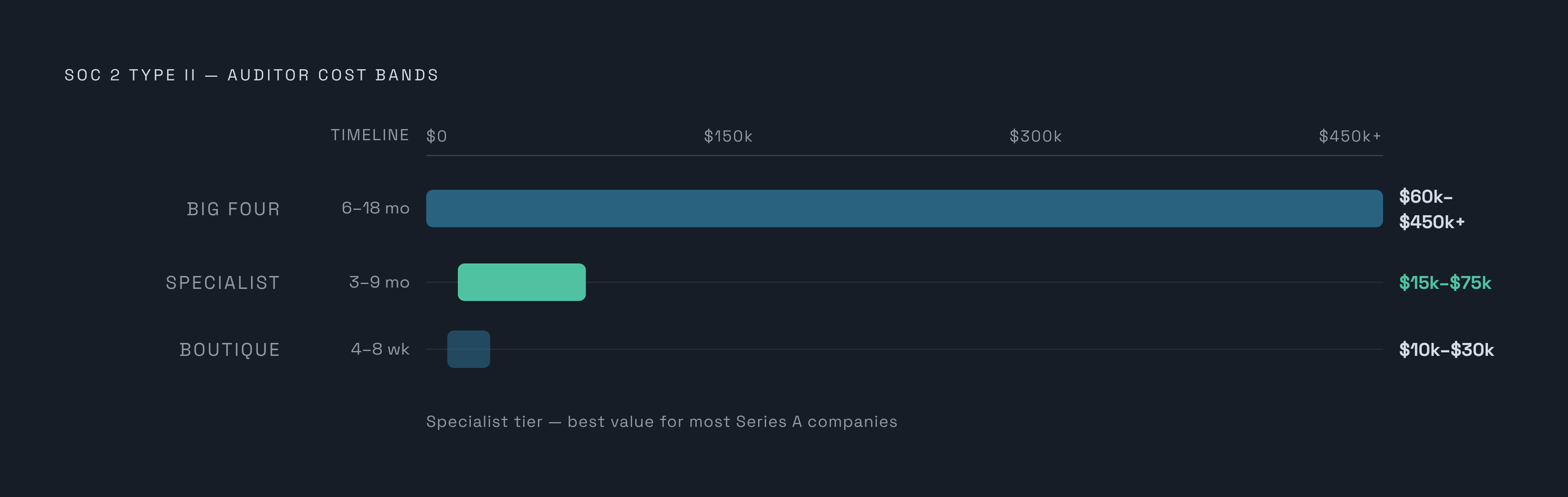
The market splits into three tiers, and cost alone tells you most of what you need to know about fit. Most Series A companies land in the middle tier, and the ones that overpay for the top tier are usually buying reassurance, not rigor.
Big Four firms (Deloitte, PwC, KPMG, EY) quote SOC 2 Type II fees anywhere from $60,000 to well over $450,000, with engagement timelines running 6 to 18 months once internal approvals and scoping get factored in. That price and timeline make sense for a company selling into procurement teams at large US enterprises that explicitly demand Big Four letterhead, or for a pre-IPO company under a specific contractual requirement to use one. For most Series A companies, none of that applies. A national or specialist firm produces the same attestation report under the same standards. The Big Four premium buys a name on the cover page, not a more rigorous audit, and paying for it at this stage is close to wasted money.
Specialist and high-volume firms are the tier that actually fits a Series A SaaS company. Type II fees here typically run $15,000 to $75,000, with timelines of 3 to 9 months. Firms in this bracket, A-LIGN, KirkpatrickPrice, Schellman, Linford & Company, Sensiba LLP, carry deep experience with SaaS environments specifically, price competitively, and hold the same AICPA-accredited CPA status as the larger names. This is where the value concentrates for most technology companies at this stage.
Boutique regional CPA firms can undercut even that. Some quote Type II engagements in the $10,000 to $30,000 range. But partner involvement and SaaS-specific methodology vary a lot from firm to firm, so price alone isn't a safe filter here. Johanson Group, based in Colorado Springs, is one example: Type I runs $10,000 to $18,000, Type II runs $15,000 to $30,000, with a 4 to 8 week timeline. It's a distinctive shop because the same LLP both signs SOC 2 reports and issues ISO 27001 certification as an IAS-accredited certification body, useful for a SaaS, fintech, or healthtech company that wants both frameworks handled by one firm.
One more variable worth weighing: how familiar the auditor is with the company's GRC platform. Auditors who already know Drata, Vanta, Secureframe, or Sprinto cut fieldwork time meaningfully, because they aren't learning the tool's evidence exports mid-engagement. Multi-year contracts negotiated up front can also knock a real chunk off the annual fee.
Profiles of the leading specialist firms for 2026, what each one does well and where it fits
Linford & Company, based in Denver, was founded in 2008 by former Big Four auditors and information security specialists (Partner Isaac Clarke started his career at Ernst & Young). The firm has worked with over 1,200 clients and holds every auditor to a minimum of ten years of professional experience. Pricing starts around $20,000, with an industry-cited range of $20,000 to $150,000 and a median near $30,000. Beyond SOC 1 and SOC 2, the firm handles HIPAA, ISO 27001, HITRUST, FedRAMP, and CMMC engagements. It fits best for a startup running its first SOC 2, where having a partner involved throughout the engagement, not just parachuting in for sign-off, cuts down on the back-and-forth of evidence collection.
KirkpatrickPricewas founded in 2005 and built its reputation on an education-forward audit style, walking clients through the "why" behind each control rather than just checking boxes. It serves SaaS, fintech, and healthcare technology clients, has worked with over 2,000 clients total, and runs a team of roughly 130 to 150 professionals. Pricing is competitive within the specialist tier. The firm covers multiple frameworks across SOC, HIPAA, and related standards. It's a strong fit for a lean, resource-constrained compliance team at Series A that needs a firm willing to explain the reasoning, not just deliver a findings list.
Sensiba LLP, headquartered in Northern California, dates back to 1977, ranks among the top 100 accounting firms in the US, and holds the distinction of being California's first accounting firm to become a B Corp. Its team blends CPAs with information security professionals who have hands-on experience across AWS, GCP, and Azure, and it integrates with major GRC platforms. Fixed-fee pricing cuts costs by roughly 25 to 30% relative to hourly billing models, most reports land within 30 days of the audit period closing, and the firm uses automated analytics software to speed up evidence review. An April 2025 acquisition of AssuranceLab brought Sensiba's combined client base past 2,300 across the Americas, APAC, and EMEA, putting it among the top three issuers of technology audit reports worldwide. It fits a company that wants cost predictability and speed from a firm that's already fluent in modern GRC tooling.
A-LIGN is among the highest-volume SOC 2 providers, with more than 36,000 total audits completed for over 6,400 clients. It operates through two entities: Price and Associates CPAs, LLC, doing business as A-LIGN ASSURANCE, its licensed CPA firm, and another affiliated entity serving as its cybersecurity consulting arm, kept separate to preserve independence. The firm is PCAOB-registered and AICPA-accredited. Its proprietary A-SCEND platform centralizes evidence collection, tracks audit milestones, and plugs into major GRC tools, backed by a 400-plus person auditor team, over 200 of whom work SOC engagements specifically. Pricing isn't published; quotes depend on scope, which TSC categories are in play, and organization size. Framework coverage runs wide: SOC 2, FedRAMP, ISO 27001, PCI DSS, HIPAA, HITRUST, and CMMC. This firm fits a Series A company that already knows SOC 2 is step one of a longer compliance roadmap, one that will eventually need ISO 27001, FedRAMP, HITRUST, or CMMC, and wants to keep all of it under a single provider as the company scales.
Schellman is a prominent independent SOC examination provider, conducting nearly 60 distinct types of audits and assessments. Its practice is split deliberately: Schellman & Company handles attest engagements, and Schellman Compliance handles non-attest advisory work, keeping independence intact while still offering advisory support under the same organizational roof. It fits mid-market to enterprise SaaS companies running complex, multi-framework compliance programs, more than most Series A companies need on day one, but worth knowing about for the growth trajectory ahead.
What a SOC 2 program actually costs at Series A: audit fees, hidden costs, and internal load
Auditor fees for a Type II engagement typically run $15,000 to $60,000 for most startups and mid-market SaaS companies. That's just the audit itself. Factor in readiness work, compliance tooling, penetration testing, and internal team time, and the total first-year program cost lands somewhere between $30,000 and $150,000, and founders who budget only for the audit line item are always the ones surprised in month six.
Type I offers a cheaper entry point, running $15,000 to $40,000 all-in, and it's a legitimate choice when controls are freshly implemented and the sales pipeline doesn't yet demand Type II.
Budget benchmarks shift with headcount. Companies with 50 or fewer employees typically see auditor fees of $12,000 to $30,000, tooling costs of $5,000 to $25,000, ongoing compliance tooling running $8,000 to $30,000 a year, and an internal compliance load of roughly 0.3 to 0.6 of a full-time employee. Companies in the 50-to-250 range see auditor fees climb to $25,000 to $60,000, tooling costs of $15,000 to $60,000, ongoing tooling running $20,000 to $80,000 a year, and internal load rising to roughly 0.5 to 1.0 FTE.
Founders consistently underestimate three costs. Penetration testing for a standard SaaS scope runs $8,000 to $25,000 in 2026, and it gets treated as an afterthought instead of a line item that belongs in the budget from day one. The internal engineering and DevOps time spent gathering evidence, fixing gaps, and maintaining controls day to day is usually the single largest cost of the whole program, hardest to pin down in advance because it depends entirely on how mature the controls already are. Scope creep is the third: when controls are thinly documented at kickoff, fieldwork stretches out and the auditor bills additional hours against the engagement that nobody budgeted for.
A few levers actually bring the cost down. An auditor already familiar with the company's GRC platform cuts fieldwork time. Negotiating a multi-year contract up front locks in a lower rate than renegotiating annually. Starting with a narrow TSC scope, Security only, then expanding in year two once the buyer conversations demand it, keeps the first audit from ballooning before the company has proven it can run one at all.
Price moves at every tier based on the same handful of factors: how many TSC categories are in scope, how complex the infrastructure is (multi-cloud setups and sprawling microservices architectures cost more to test than a single-cloud monolith), whether readiness work got done before the audit period even opened, and the auditor's own geography, since some firms use offshore labor models that shift their pricing structure.
The evaluation criteria that actually separate
Price and firm name are the two variables most founders anchor on first, and they're the least useful ones for predicting whether the audit goes well. Chasing the cheapest quote or the most recognizable letterhead solves for the wrong variable entirely. What actually separates a smooth engagement from a painful one comes down to a shorter list: how deeply the firm's team understands SaaS infrastructure specifically, rather than generic IT controls; how responsive the assigned engagement team stays once fieldwork starts and evidence requests pile up; and whether the firm's GRC tool integrations match what the company already runs internally.
Independence discipline matters just as much, standing as the one criterion that's non-negotiable rather than a matter of taste. A firm that also wants to sell ongoing advisory or readiness work risks the exact self-review conflict the AICPA's late-2025 clarifications were written to catch. The cleanest engagements come from firms that draw a hard line between the team that helps build controls and the team that tests them, and any firm blurring that line should be crossed off the list regardless of price.
Timeline realism is the last piece, and it's where sales pressure does the most damage. A firm that promises a six-week Type II turnaround for a company with undocumented access controls and no incident response history is cutting corners it shouldn't. It's setting up a scope surprise three weeks in, once the auditor actually opens the environment and finds gaps nobody flagged at kickoff. The firms worth choosing ask hard questions about control maturity before quoting a timeline at all, because that conversation determines whether the report lands in the enterprise buyer's inbox on schedule, or two quarters late, after the deal has already gone cold.