ISO 27001 vs SOC 2 for US SaaS Companies Selling to Enterprise
Enterprise buyers in the US expect SOC 2; international markets demand ISO 27001.
Founders keep asking which framework is better. That's the wrong question, and it's costing some of them six figures. SOC 2 and ISO 27001 solve different problems for different buyers in different parts of the world, so the question that actually matters is where the revenue sits. Get that answer wrong and you'll fund a credential nobody in your pipeline asked for, while the deal that needed the other one sits stalled in procurement.
Picture a growth-stage SaaS company that gets two procurement emails in the same week. One comes from a US-based enterprise prospect asking for a SOC 2 report. The other comes from a client in Europe asking for an ISO 27001 certificate. Neither buyer cares what the other one wants, and neither requirement is negotiable. That's the whole decision, and it hinges on where deals close and what procurement teams put on their checklists, not on which framework sounds more prestigious in a board deck.
What each framework produces in a vendor review
SOC 2 produces an attestation report, issued by a licensed CPA firm. A company either holds one or it doesn't. There's no such thing as being "SOC 2 certified," and any sales rep who uses that phrase has just told you how loosely that company understands its own compliance posture. Treat it as a warning sign.
ISO 27001 produces a formal certificate issued by an accredited certification body, valid for three years and kept alive with annual surveillance audits in between. That structural difference drives a commercial one. SOC 2 reports are restricted-use documents, shared under NDA or dropped into a data room during due diligence, because the buyer's security team wants to read the actual control descriptions and auditor findings, not just confirm a logo exists. ISO 27001 certificates are public by design. They show up on vendor management spreadsheets, procurement portals, and company websites, and confirming one is valid takes no signature.
Companies that want a public signal from their SOC 2 work without exposing the full report should discuss with their auditor what summary options are available once the SOC 2 examination wraps.
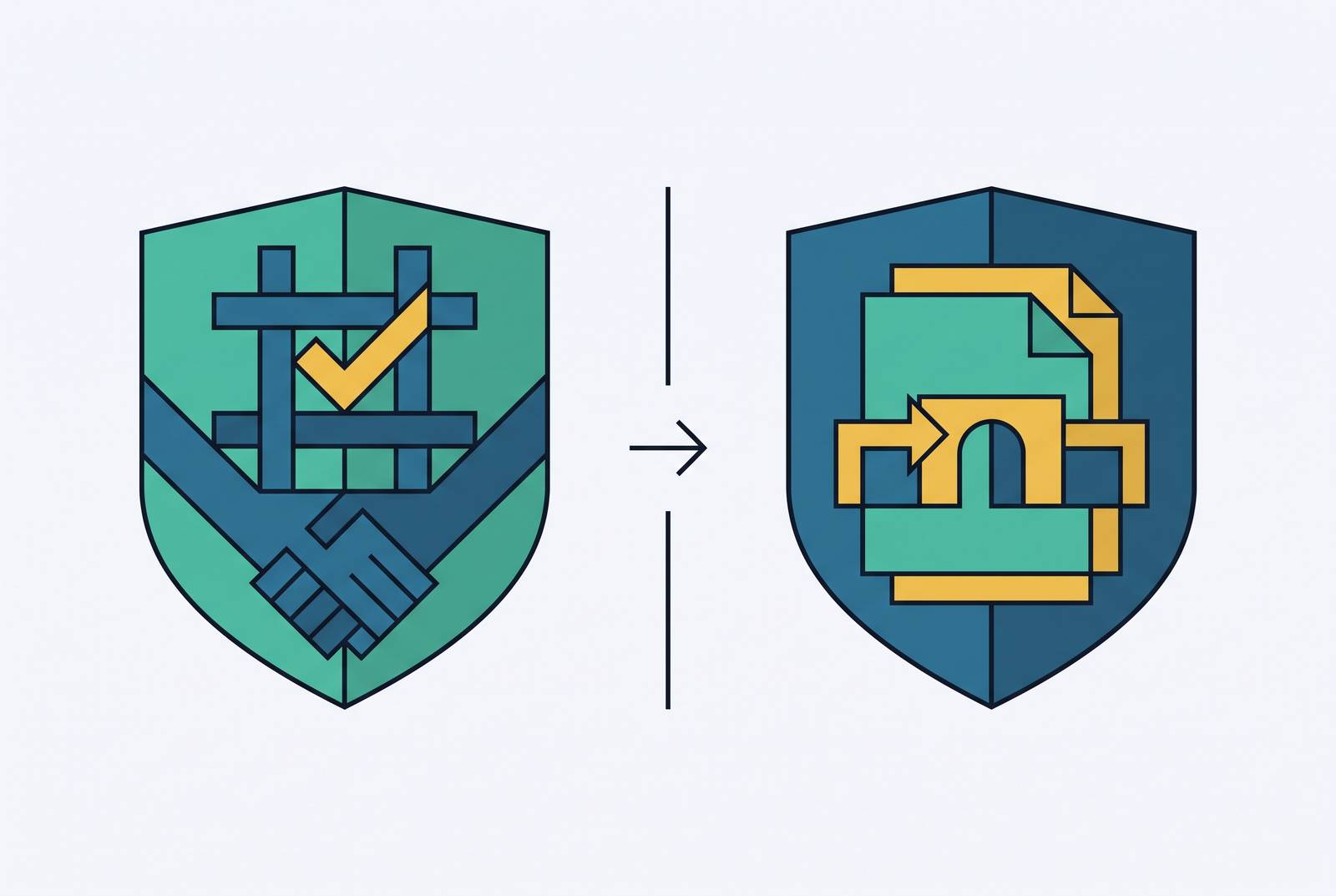
A philosophical difference underlies this: SOC 2 and ISO 27001 rest on different assumptions about what proof of security should look like, and that difference shapes how buyers read the document even though most never say it out loud. SOC 2 demonstrates operational reliability in the present tense: these controls performed as intended, over this specific period, full stop. ISO 27001 is built around institutional accountability over time, an information security management system meant to keep those controls, and the thinking behind them, maturing after the certificate ships. One is a photograph. The other is a standing commitment to keep improving the system that took the photograph.
SOC 2 as the Default Expectation for US Enterprise Sales
In US B2B SaaS, SOC 2 stopped being a differentiator years ago. It's table stakes now. Enterprise procurement teams don't reward a vendor for having one so much as they refuse to move forward with a vendor that doesn't. The report exists because security teams at large buyers need a consistent way to evaluate dozens, sometimes hundreds, of SaaS vendors at once, and a custom security questionnaire for each one doesn't scale. A standardized, CPA-audited report lets procurement process vendor risk without reinventing the evaluation from zero every time.
Missing a SOC 2 Type II can stall or kill a deal with a Fortune 500 buyer. A sophisticated buyer treats it as the floor, proof that a vendor's controls function day to day, not as a premium credential worth extra credit.
Certain verticals push this further. In financial services and banking, a Type 2 report is effectively mandatory for third-party risk review, and a Type 1 alone won't clear that process. In healthcare, HIPAA-obligated buyers expect Type 2 as a baseline, and larger health systems sometimes ask for HITRUST on top of it. The pattern holds across every regulated vertical: the more scrutiny the buyer faces from its own regulators, the less room there is to substitute a lighter framework for the real thing.
ISO 27001 as the Necessary Credential for International Markets
Outside North America, the default flips: ISO 27001 is the benchmark for information security, and buyers and regulators elsewhere often expect it before SOC 2 even enters the conversation. Singapore, Japan, South Korea... Outside North America, ISO 27001 is the benchmark for information security, and buyers and regulators elsewhere often expect it before SOC 2 even enters the conversation. Singapore, Japan, South Korea, the UK, and EU member states such as Germany, France, the Netherlands, and the Nordics all lean on ISO 27001 as the credential their procurement teams recognize on sight, no explanation required.
Regulation is tightening this, not loosening it. DORA's enforcement, which began in January 2025, has pushed a wave of SaaS companies serving EU financial institutions toward holding SOC 2 and ISO 27001 at the same time. ISO 27001's ISMS backbone, covering risk management, incident response, and access control, overlaps meaningfully with what DORA and NIS2 expect from a vendor's security program. That overlap isn't a substitute for compliance, though. ISO 27001 makes meeting those regulations easier; it doesn't check the box on its own.
What makes ISO 27001 valuable internationally is what separates it from a SOC 2 report. It appears on procurement portals with no NDA required, and it signals security governance at the organizational level rather than controls scoped to one service. It's recognized across more than 160 countries, a reach no attestation report tied to a single domestic market can match.
SOC 2 Type 1 vs. Type 2 sequencing in enterprise deals
Type 1 is a point-in-time assessment: are the controls designed correctly, as of this date? Type 2 asks the harder question. Did those controls actually operate consistently over a defined stretch of time? The observation window typically runs several months, long enough to catch a control that looks fine on paper but breaks down the first time someone's on vacation and a backup approver has to step in.
Most enterprise, financial services, and healthcare buyers require Type 2. Type 1 gets treated as a transitional credential, acceptable early in a vendor relationship but not something that survives a renewal cycle or a serious long-term partnership review. Type 2 reports cover a defined observation period, after which the cycle resets with a new audit.
Most companies get this sequence backwards, and it costs them a year of stalled deals. The right order: remediate the obvious gaps, run a readiness assessment, earn the Type 1, and open the Type 2 observation window the same week the Type 1 lands. That gives sales a document to hand a buyer immediately, while the Type 2 clock runs quietly in the background. Companies that skip Type 1 and jump straight into a Type 2 observation window spend months with nothing to show procurement, stalling enterprise deals on a document that doesn't exist yet. That mistake is entirely avoidable, and it happens constantly anyway.
Scoping the SOC 2 audit: which Trust Services Criteria to include
SOC 2 audits run on five Trust Services Criteria: Security, Availability, Processing Integrity, Confidentiality, and Privacy. Security is the only mandatory one. Everything past that is a scoping decision, and it shapes what a buyer sees when the report lands on their desk.
For most enterprise SaaS companies, the sensible baseline is Security plus Availability plus Confidentiality. These are the three categories enterprise security teams scrutinize hardest during vendor risk review, and adding the latter two to a Security-only audit costs relatively little set against the cost of a buyer noticing they're missing.
Processing Integrity earns its place when a company handles payments, trades, or any transaction where data accuracy is effectively the product being sold. Privacy comes into scope when a company processes personal information, including data used to train AI or ML models, or when a specific buyer requires it by name.
Scoping is also where audits go sideways most often. A system description defined loosely at the outset becomes the foundation every later finding rests on, and a shaky foundation produces scope creep, surprise evidence requests, or a report that doesn't answer the questions the buyer was actually asking. Getting the control list and system description right at the start heads off most of what derails an audit timeline later.
ISO 27001:2022 requirements
Any conversation about ISO 27001:2013 today is a conversation about a lapsed version. Organizations had until October 31, 2025 to migrate to ISO 27001:2022, and that deadline has come and gone. Planning around the 2013 structure now means planning around a certification that no longer exists in valid form. There's no ambiguity left here, and no reason to hedge on it.
The 2022 edition restructured the standard substantially. The 2013 version organized 114 controls across 14 domains. The 2022 version condensed that into 93 controls across four themes: Organizational, People, Physical, and Technological. Eleven of those controls are entirely new, addressing cloud computing, remote work, and threat intelligence directly, which amounts to a fairly blunt admission that the risk landscape SaaS companies operate in looks nothing like it did in 2013.
Certification runs on a three-year cycle: the initial audit, annual surveillance audits in years two and three, then a full recertification audit before the cycle starts again. It isn't a one-time achievement so much as a recurring obligation, and that's part of why buyers treat the certificate as a signal of ongoing governance rather than a snapshot frozen at the moment of issue.
The control overlap between the two frameworks
The two frameworks share far more than they differ on. Depending on how the mapping is done, overlap between SOC 2 and ISO 27001 controls runs somewhere between 70% and 90%. A company that has already built out a SOC 2 program has done most of the structural work ISO 27001 demands. The incremental lift of the second framework is a fraction of what building either one from scratch would cost, and that's the single biggest reason companies serving both US and international buyers pursue both instead of picking one.
This is where GRC tooling actually earns its cost. A platform that maps shared controls once, instead of treating each framework as its own isolated project, lets a company satisfy both audits without doubling the evidence-collection work. Cloud configuration testing, evidence gathering, and policy documentation can serve both audits at once rather than running as two parallel, redundant efforts that ask the same engineer for the same screenshot twice.
The cost impact of automating that mapping isn't small. Platforms built for this can cut total compliance program costs by 60% to 80% against a fully manual approach, turning compliance into a rounding error on the budget instead of a project that eats a meaningful chunk of an early engineering team's quarter.
Cost and timeline realities for SOC 2 and ISO 27001
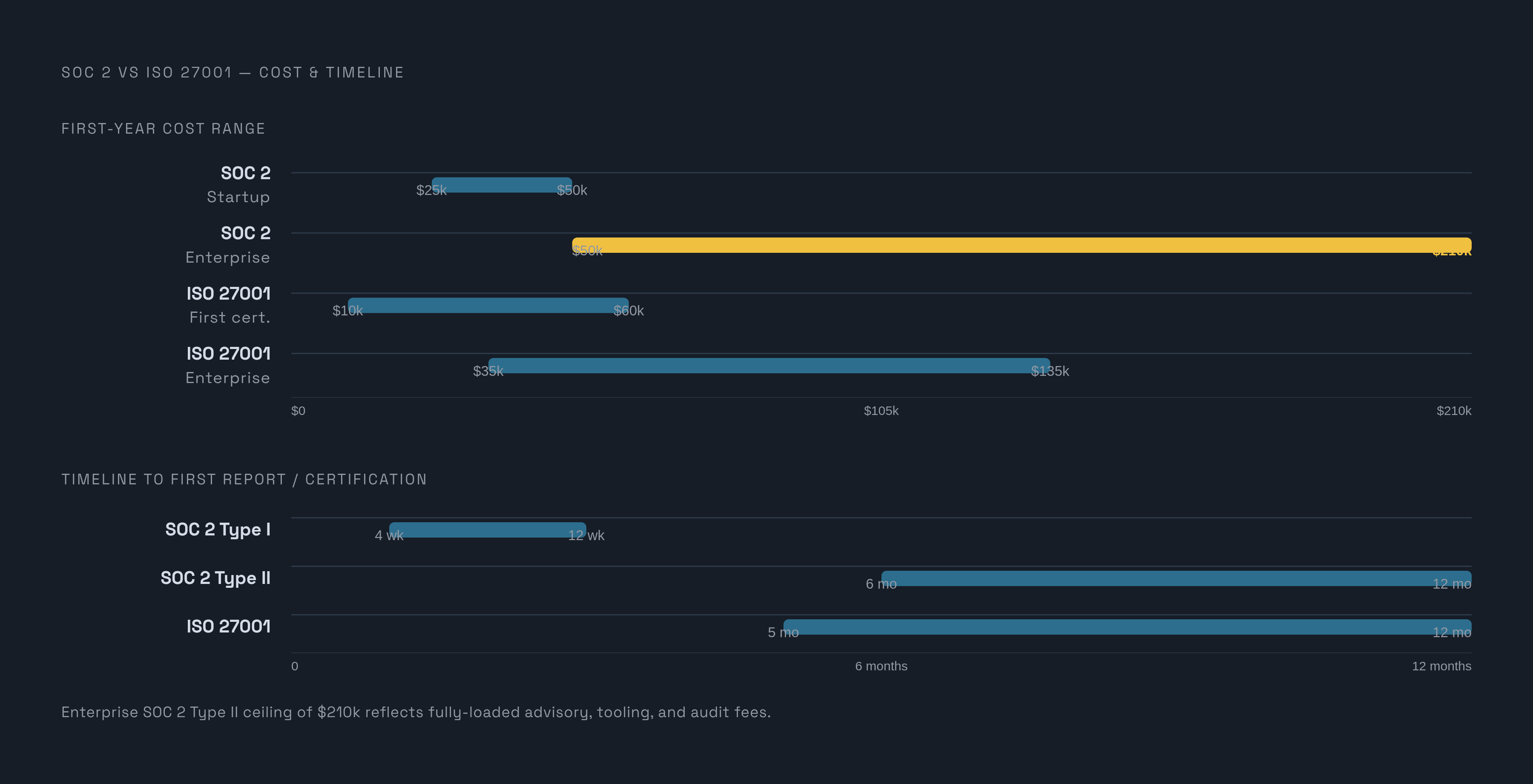
SOC 2 costs break down into recognizable bands. A Type 1 audit fee alone runs $15,000 to $25,000. Type 2 runs higher, $30,000 to $45,000, reflecting the extra testing work across the observation period. Most startups spend $25,000 to $50,000 in total for a first-year SOC 2 program once the audit fee, compliance platform, and internal tooling get added together, and the auditor's fee usually accounts for only 30% to 40% of that total. The compliance platform, not the audit itself, is often the single largest line item on the invoice, which surprises nearly everyone budgeting for this for the first time.
Internal time never appears on an invoice, but it is real money all the same, and it is measured in the hours a security team spends running the program. At a mid-level security engineer's fully loaded rate, the hours a SOC 2 program consumes carry an opportunity cost somewhere between $11,250 and $30,000. At enterprise scale, total year-one Type II spend, all-in, can run anywhere from $50,000 to $210,000.
ISO 27001 follows a similar shape with a lower ceiling for smaller companies. First-time certification costs generally fall between $10,000 and $60,000. The external certification audit cost varies considerably by company size, and a full three-year certification cycle can reach $75,000 in hard costs before internal time gets counted. Companies that bring in outside consultants to help build the ISMS should expect to pay $15,000 to $40,000 for that help. At enterprise scale, first-year ISO 27001 spend runs $35,000 to $135,000.
Timelines diverge more than costs do. A SOC 2 Type 1 can move from readiness to finished report in four to twelve weeks. Type 2 is slower by design: the three-month minimum observation period stretches the realistic timeline, from decision to finished report, to somewhere between six and twelve months. ISO 27001's implementation and certification process typically takes several months as well, and once the full ISMS build gets factored in, the elapsed time lands close to a SOC 2 Type 2 engagement.
The line most planning spreadsheets miss is the jump from Type 1 to Type 2, stacked on top of internal team hours that never appear on any vendor invoice, yet end up, in nearly every case, as the largest true cost of the whole program.